
How to Value a Domain Name: A 6-Factor Rubric (2026)
How to value a domain name in 2026 — a 20-year investor's 6-factor appraisal rubric (length, brandability, TLD, demand, history, comps) and how to turn it into a max bid.
 Mark FultonJun 30, 12:00 AM UTC11 min read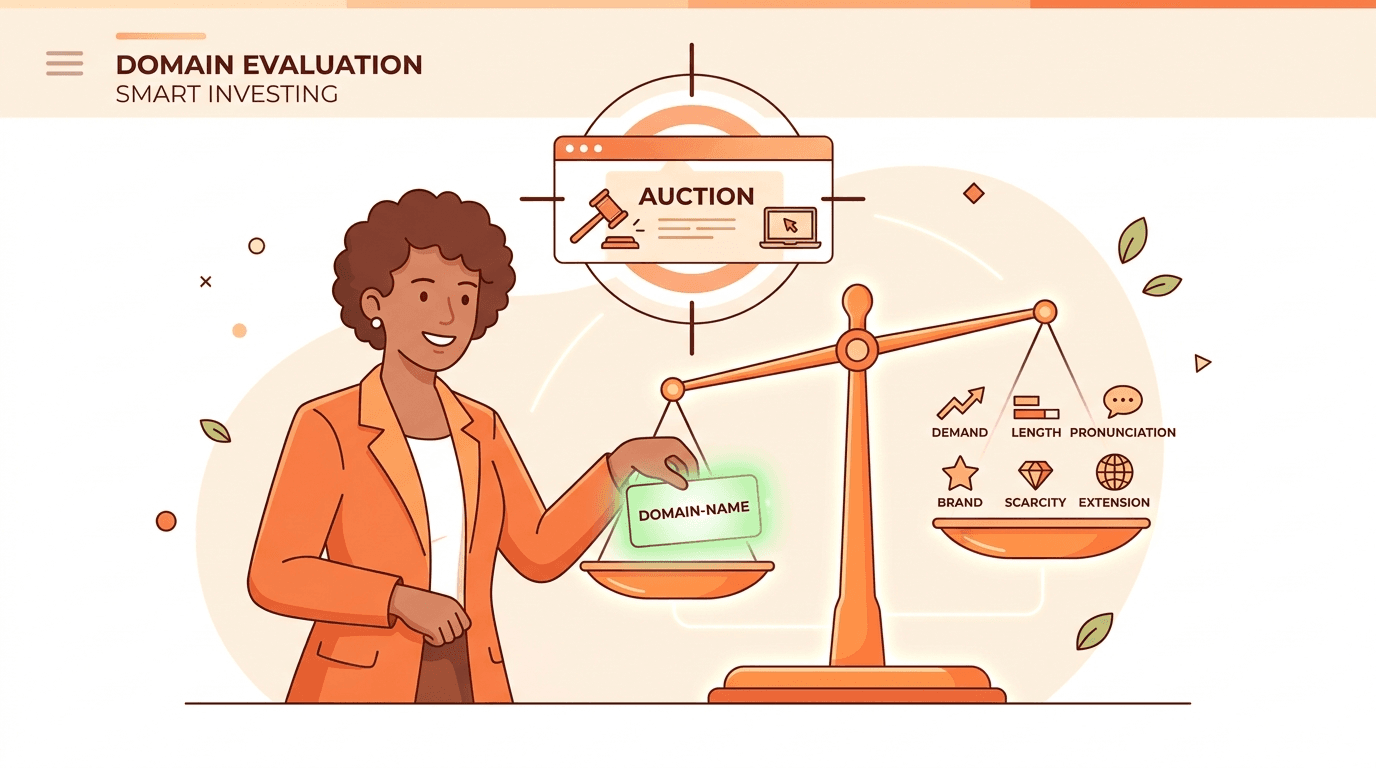
To value a domain name, score it across six factors that actually move the resale market — length, brandability, TLD, keyword demand, history, and comparable sales — then anchor the number to real comps rather than a gut feeling. Comparable sales do the heaviest lifting: find what genuinely similar names have recently sold for, then adjust up or down for the other five factors. The honest output is a range, not a single price, and the whole exercise only pays off when you convert that range into a disciplined maximum bid before you ever enter an auction.
I’ve been buying, building, and flipping domains for over 20 years, and the most expensive mistakes I’ve watched investors make all trace back to the same root cause: they fell in love with a name and skipped the appraisal. A domain is only worth what a real buyer will pay, and the job of valuation is to estimate that number coldly. This guide is the framework I use — a weighted six-factor rubric, a comp-reading walkthrough, an honest take on appraisal tools, and the part almost nobody teaches: turning a valuation into a maximum auction bid.
The six factors that set a domain’s value
Every credible appraisal — human or machine — comes back to the same six levers. None of them work in isolation; a domain’s value is the product of all six together, which is exactly why a single online estimator so often misses.
- Length. Shorter is scarcer and almost always more valuable. One- and two-word names and short letter strings command a premium because there are only so many of them — see what 4-letter (LLLL) domains are worth for how far scarcity alone carries a name, and why a two-word .com is the workhorse of brandables for the tier just above it, and what a single dictionary word is really worth for the tier above that. Every additional character thins the buyer pool — though only up to a point, which is why length stops paying past about six characters.
- Brandability. Can a buyer say it, spell it after hearing it once, and put it on a billboard? Pronounceable, memorable names sell; clunky, ambiguous ones sit unsold. This is the factor machines judge worst and experienced investors judge best — I break down exactly how to score it in how to spot a brandable domain.
- TLD. The extension is a liquidity multiplier.
.comis the most liquid resale TLD on earth — the default buyers reach for and the one with the deepest pool of comparable sales. Other extensions can work in the right niche, but they narrow demand. - Keyword demand. Does the name map to a commercial term people actually search and build businesses around? Real end-user demand — a category, a product, a city + service — is what turns a name from a speculation into an asset someone needs.
- History. A clean, single-topic past with legitimate age and backlinks adds value; a spammy, gambling, or trademark-tainted history destroys it. Always check before you bid.
- Comparable sales. What have genuinely similar names actually sold for? This is the evidence that grounds the other five factors in reality instead of optimism.
A weighted appraisal rubric you can actually use
Here is the scorecard I run a candidate through. Rate each factor 0–5, multiply by its weight, and total the points. The weights reflect what the market rewards — liquidity (TLD), brandability, and length carry the most, because they decide whether a buyer exists at all. The point band at the bottom translates the score into a rough resale range, which you then sharpen with comps.
| Factor | Weight | 0–1 (weak) | 3 (solid) | 5 (premium) |
|---|---|---|---|---|
| TLD / liquidity | ×3 | Obscure new gTLD, high renewal | .co / .io / .ai in its niche | .com |
| Brandability | ×3 | Unpronounceable or ambiguous | Readable, slightly generic | Say-it-once, billboard-ready |
| Length | ×2 | 4+ words / 7+ letters random | Two-word or 5–6 letters | One word or LLL/LLLL |
| Keyword demand | ×2 | No commercial meaning | Niche term, some intent | Hot category, end-user buyers |
| History | ×1 | Spam / trademark risk | Neutral, no red flags | Clean, aged, real backlinks |
| Comp support | ×1 | No comparable sales | A few loose comps | Tight, recent comps |
Maximum score is 60. As a rough read: under 18 is a pass (junk or pure lottery ticket), 18–32 is a modest flip candidate worth a small, comp-disciplined bid, 33–46 is a genuine keeper, and 47+ is a premium name where the ceiling is set by demand, not by the rubric. Treat the bands as a sorting tool, not a price tag — the actual number always comes from comps.
How to read comparable sales (the part that matters most)
Comps are the single most reliable input in domain valuation, and the one the generic guides hand-wave. The free, public source investors trust is NameBio, a database of reported domain sales. The skill is matching on the dimensions that actually transfer value:
- Same length and pattern. A five-letter pronounceable .com compares to other five-letter pronounceable .coms — not to a one-word dictionary name.
- Same TLD. A .com sale tells you almost nothing about a .xyz price and vice versa. Match the extension.
- Recent, not record-breaking. Read the sales from the last year or two and ignore the headline mega-sales — they’re outliers that will only inflate your expectations.
Three or four tight comps tell you more than any tool — I walk the exact search, a full worked example, and the wholesale-vs-retail read in how to use NameBio domain sales to price with comps. If similar names cluster around $300–$600 and you can buy yours for under $100 net of fees, you have an edge. If the comps are all over the map, the name is illiquid and you should bid like it. The reason .com keeps winning here is liquidity: there are simply more .com comparables to triangulate from, which is one of several reasons it stays the core of most portfolios — I break the extensions down in Best TLDs for Domain Investing.
Are domain appraisal tools accurate?
Honestly? They’re a starting point, not an oracle. Automated appraisers like GoDaddy’s, Estibot, and HumbleWorth lean on machine learning over past sales, so they’re reasonably good on one-word keyword and dictionary names where the comparable data is dense — and noticeably weaker on brandables and newer TLDs, where every name is unique and the model is essentially guessing. I run two or three, treat the spread between them as a sanity check, and never quote a single machine number to a buyer or use one to justify a bid. The tool narrows the range; comps and judgment set the price. For which tool to trust on which kind of name, see my ranking of the best domain appraisal tools.
This is also where AI changes the workflow. A language model can judge the thing rule-based tools can’t — whether a coined name reads as a brand — and score thousands of candidates consistently across the lenses you care about. That’s the engine inside PounceDomains: instead of pasting one name into one appraiser, it scores every ending-soon Namecheap auction across your chosen strategies and surfaces only the names that clear your bar. For the mechanics — the lenses, the prompts, and the honest limits — see AI domain name evaluation: where AI beats regex.
How do you get a value for one specific domain?
Everything above is a rubric, and a rubric is a way of thinking rather than an answer. The far more common need is narrower: you have one name in front of you and you want a number for it today. Here is that process end to end, in the order I actually run it.
Start with comps, not with a tool. Search the sales record for the closest names you can find and write down what they actually sold for, not what they were listed at. Asking prices are aspirations; recorded sales are evidence. Three genuinely comparable sales beat thirty loose ones, and if you cannot find three, that absence is itself the finding: a name with no comparable sales is a name whose price nobody has tested.
Then run two or three automated appraisals and keep the spread, not the average. If the tools cluster tightly, the name sits in dense data and the estimate is worth something. If they disagree by a factor of five, the model is extrapolating and the number is noise. Recording the range rather than a single figure is what keeps you honest later, when it is tempting to remember the highest one.
Then apply the discount nobody applies to themselves.A resale estimate describes what the name might fetch from a motivated buyer over an unknown period, frequently years. It is not cash today. The gap between an estimate and a realistic sale price is mostly liquidity, and it is wide for anything that is not a short, obvious, keyword-dense .com.
Then decide what the number is for, because the same name is worth different amounts depending on the question. A maximum bid is a different figure from an asking price, which is different again from a defensible valuation for a third party. Turning the estimate into a bid you can act on is the maximum bid section below.
Why the same domain gets three different valuations
Anyone who has typed a name into more than one appraisal box has seen this and wondered which one lied. Usually none of them did. They answered slightly different questions.
The largest source of disagreement is what each model counted as a comparable sale. Publicly recorded domain sales are a thin and biased slice of all domain sales, because private transactions and escrow deals frequently go unreported and marketplaces publish selectively. A model trained on one slice sees a different market from a model trained on another, and neither sees the whole thing. Reported sales databases are the best evidence available and still an undercount, which is why comps set a floor for confidence rather than a ceiling.
The second source is the TLD. Valuation confidence tracks data density, and data density tracks age and volume. Legacy extensions have decades of recorded sales behind them; the registry data that Verisign publishes in its Domain Name Industry Brief exists because that part of the market is large enough to measure quarterly. Newer extensions have a fraction of that history, so estimates on them carry far more model and far less evidence, which is exactly where the tools diverge most.
The third is timing. Estimates move as new sales are recorded and as models are retrained, so a valuation is a reading taken on a date rather than a permanent property of the name. If you are keeping a valuation on file for any purpose that matters, keep the date next to it. The names themselves also move through the ICANN expiry lifecycle, so a name that is expiring is worth checking again on the other side of that clock.
The practical rule that follows: treat a single automated number as one opinion among several, treat a tight cluster as a signal, and treat a wide spread as a warning that you are the one who has to make the call.
Turning a valuation into a maximum bid
Valuation is academic until it produces a number you’ll act on. A resale estimate is not your bid — your bid is what’s left after you subtract every cost and the profit you want. On the Namecheap Market that math is concrete:
- Start with a conservative resale estimate — the low end of your comp range, not the dream number.
- Subtract the profit margin you require to make the flip worth your time and the risk it doesn’t sell.
- Subtract acquisition costs. Namecheap charges a 10% buyer’s premium on the winning bid plus the first-year registration (per Namecheap), and you’ll renew the name every year you hold it. Bidding also requires a Market subscription (about $5/year) and a minimum account balance.
- What remains is your true maximum. Decide it before the auction and treat it as final.
Say comps support a conservative $500 resale, you want at least a 3× return, and you budget ~$30 for the premium plus registration and the first renewal. That puts your ceiling near $130–$140 — and because proxy bidding only ever raises you one increment above the next bidder, you’ll usually pay less. The cost mechanics are worth knowing cold; I lay them out in Namecheap Market Fees Explained and the bidding mechanics in Namecheap Proxy Bidding Explained. The cardinal rule: set your max from the appraisal, then never chase past it.
The valuation mistakes that cost real money
- Trusting one appraisal number. A single tool’s output is the most common reason investors overpay. Cross-check with comps, always.
- Ignoring history. A name that appraises beautifully can be worthless if its past is spam or it infringes a trademark. Check before you value, not after you buy — start with how to find valuable expired domains.
- Confusing “clever” with “liquid.” A name you find witty may have zero real buyers. Weight every appraisal by how many actual end users exist for it.
- Forgetting carrying cost. Renewals compound. A name that won’t sell isn’t free to hold — it quietly drains the portfolio every year.
The bottom line
Valuing a domain isn’t guesswork and it isn’t a single tool reading. Run the name through the six factors, weight it with the rubric, ground it in real comps, sanity-check with an appraiser or two, and then convert the range into a maximum bid net of fees and renewals. Do that consistently and your wins stop being luck. If you’d rather not appraise thousands of auctions by hand, that’s exactly what PounceDomains automates — it scores every ending-soon Namecheap name with AI so your attention goes only to the ones worth a bid. Start free and let the appraisal run itself. For the wider playbook on turning appraisals into profit, see How to Make Money Flipping Domains.
Frequently asked questions
How do you value a domain name?
Score it across six factors that actually move the resale market: length, brandability, TLD, keyword demand, history, and comparable sales. After 20+ years, comps do the heaviest lifting — find what genuinely similar names (same length, pattern, and TLD) have recently sold for on NameBio, then adjust up or down for the other five factors. The number you land on is a range, not a single price. Appraisal tools can seed that range, but treat them as a starting point, never the final word.
Are domain appraisal tools accurate?
They're directional, not gospel. Automated appraisers — GoDaddy, Estibot, HumbleWorth — are decent at one-word keyword and dictionary names where they have dense comparable data, and noticeably weaker on brandables and newer TLDs where every name is unique. The honest way to use them is as one input: run two or three, treat the spread as a sanity check, and always cross-reference real comparable sales yourself rather than trusting a single machine number.
How do I find comparable sales for a domain?
Use NameBio, the public database of reported domain sales. Search for names that match yours on the dimensions that matter — same character length, same pattern (e.g. CVCVC, two-word, dictionary), and the same TLD — and read the recent ones, not the record-breakers from years ago. Three or four close comps tell you far more than any appraisal tool. .com stays the most liquid resale extension, which is why .com comps are the easiest to find and the most reliable.
How do I turn a domain's value into a maximum auction bid?
Start from a conservative resale estimate, then work backward through your costs. On the Namecheap Market you pay a 10% buyer's premium on the winning bid plus the first-year registration (per Namecheap), and you'll renew the name every year you hold it. Subtract those, subtract the profit margin you want, and what's left is your true maximum bid. Decide that number before the auction and don't chase past it — disciplined max-bidding, not emotion, is what makes flips profitable.
What is the single biggest factor in a domain's value?
Liquidity — how easily you can actually sell it — which mostly comes down to the TLD and how brandable or in-demand the name is. A short, pronounceable .com has a deep pool of potential buyers and comparable sales; an obscure new-TLD name might appraise high on paper but have almost no real demand. Always weight a domain's value by how many real buyers exist for it, not just how clever the name sounds.
How do I find out what my specific domain is worth?
Work in this order. First find comparable recorded sales, using what names actually sold for rather than what they were listed at, because asking prices are aspirations and recorded sales are evidence. Three genuinely comparable sales beat thirty loose ones, and if you cannot find three, that absence is the finding: nobody has tested the price of a name like yours. Second, run two or three automated appraisals and keep the spread rather than the average, because a tight cluster means dense data and a five-fold disagreement means the model is extrapolating. Third, discount for liquidity, since a resale estimate describes what a motivated buyer might pay over an unknown period rather than cash today. Fourth, decide what the number is for, because a maximum bid, an asking price and a defensible third-party valuation are three different figures for the same name.
Why do appraisal tools give different values for the same domain?
Usually because they answered slightly different questions. The biggest cause is what each model counted as a comparable sale: publicly recorded domain sales are a thin and biased slice of all sales, since private and escrow transactions often go unreported and marketplaces publish selectively, so models trained on different slices see different markets. The second cause is the TLD, because valuation confidence tracks data density and legacy extensions carry decades of recorded sales while newer ones carry a fraction of that, which is where estimates diverge most. The third is timing, since estimates shift as new sales are recorded and models are retrained, making any valuation a reading taken on a date rather than a fixed property of the name. Treat one number as one opinion, a tight cluster as a signal, and a wide spread as a warning that the judgement is yours.
Mark Fulton
Developer & Founder of PounceDomains · 20+ year domain investor
Mark Fulton is a 20+ year domain investor and the developer and founder of PounceDomains. He has spent two decades buying, building, and flipping domain names, and built PounceDomains himself to automate the hunt for undervalued domains on the Namecheap aftermarket.
Keep reading
Short Domain Names: Where Length Stops Paying (2026)
Are short domain names better? A 20-year investor's length-vs-value ladder — the scarcity math, the six-character crossover where length stops paying, and the tradeoffs.
Dictionary Word Domains: Real Words, Real Demand (2026)
Are dictionary word domains valuable? A 20-year investor's category value ladder — which real words hold demand, which don't, and how to catch one on the aftermarket.
Snipe these domains automatically
PounceDomains watches Namecheap Market 24/7, scores every ending-soon domain with AI, and bids on the winners. Free to start.
Start sniping free