
Domain Drop Catching vs. Auctions: Which Wins? (2026)
Domain drop catching or an aftermarket auction? A 20-year investor compares how each works, the real costs, and which to use to land an expiring name in 2026.
 Mark FultonJul 3, 12:00 AM UTC8 min read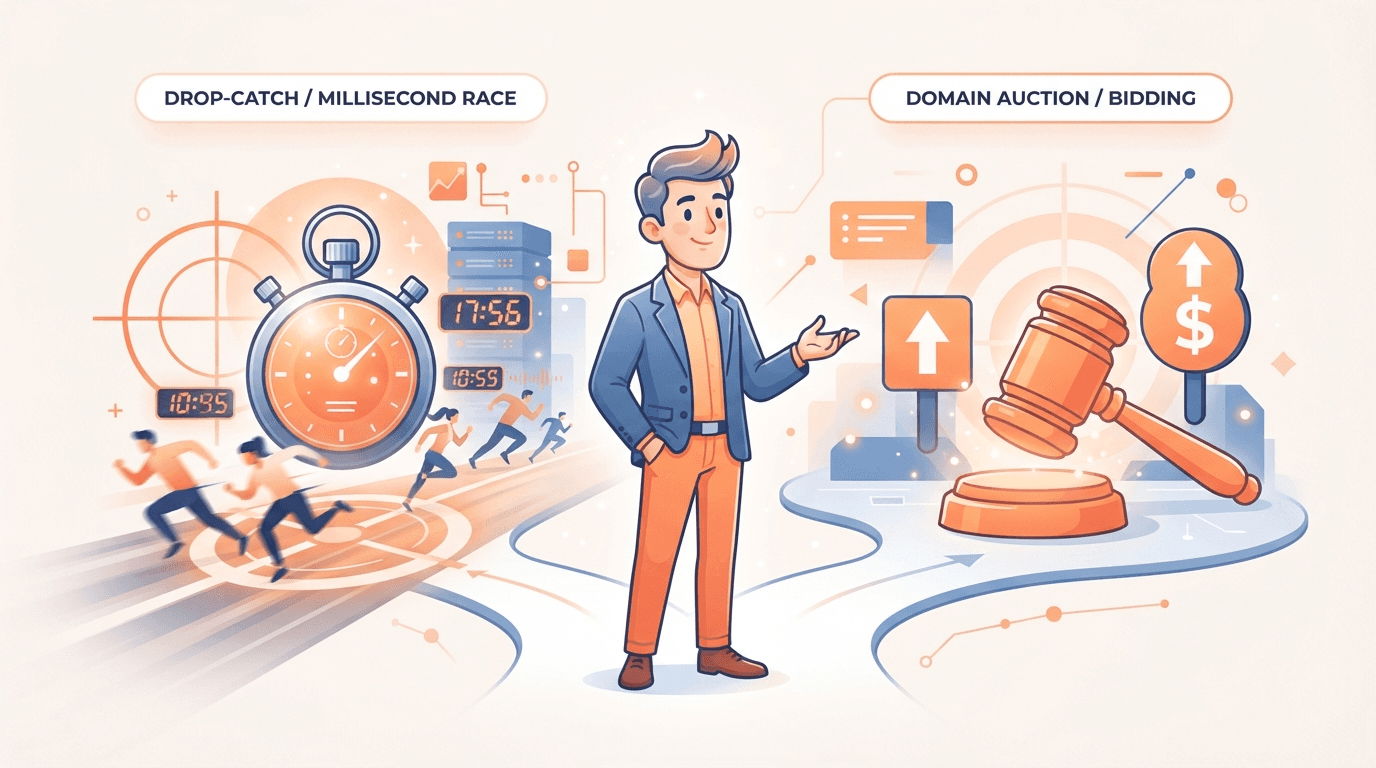
Domain drop catching and aftermarket auctions are two different ways to grab an expiring name, and they intercept it at opposite ends of its life. Drop catching races to re-register a name the microsecond it’s deleted from the registry — an invisible, automated speed contest with no guarantee you’ll win. An aftermarket auction sells the name before it fully drops, through transparent proxy bidding you control from your own account. For most investors most of the time, the auction is the simpler, higher-yield path; drop catching is the specialist tool for a specific named target you’re willing to chase and possibly lose.
I’ve been buying and flipping domains for more than twenty years, and “should I drop-catch this or bid on it?” is a question I still get asked constantly — usually by people who’ve conflated the two. They’re not competing tools for the same job. They’re two stations on the same railway line, and which one you use depends entirely on where the name is in its lifecycle and how badly you need that exact name. Let me lay both out honestly, then give you a decision you can actually act on.
What is domain drop catching?
Drop catching is registering a domain at the precise instant it’s released back into the public pool. When an owner lets a name lapse, it doesn’t vanish immediately — it walks through a standard lifecycle first:
- Auto-renew grace period. The name expires but the original owner can still renew it at the normal price.
- Redemption period. Renewal gets more expensive (registries charge a redemption fee), but the owner can still pull it back.
- Pending delete. A fixed ~5-day window (the ICANN standard for gTLDs) where nobody — not even the former owner — can recover the name.
- The drop. Pending delete ends, the registry deletes the name, and it’s available to register again. This exact moment is what drop catching targets.
Here’s the catch (pun intended): you cannot beat this manually. Professional drop-catch services fire thousands of registration requests per second from optimized infrastructure, so the difference between winning and losing is measured in milliseconds and comes down to server positioning and how the registry handles the contention. You hand a service your target names in advance; if it catches one, you pay a catch fee and the name is yours. If two of its customers wanted the same name, it typically runs a private auction between them. Miss the catch, and you usually pay nothing — but you also get nothing.
How does that differ from an aftermarket auction?
An aftermarket auction intercepts the name much earlier — while it’s still in the expiry pipeline, before it ever reaches that final deletion. Rather than letting a valuable expiring name drop into a millisecond free-for-all, registrars and marketplaces auction it off. You bid against other buyers, in the open, with a known closing time, and the highest bidder wins and takes over the registration.
The Namecheap Market is a clean example. Names that weren’t renewed get listed as auctions that typically run about seven days (per Namecheap), all closing together in the day’s 11:00 AM ET batch. You bid through your own account with proxy bidding, a late bid can extend an individual auction (the anti-snipe rule), and if a name attracts no bids it can roll into a reduced $5 closeout (per Namecheap). The whole thing is transparent and controllable — the opposite of the drop’s hidden speed race. I break the full mechanics down in Namecheap Market Auctions Explained.
The key mental model: a name being auctioned is not a name you can drop-catch, because the registrar has pulled it out of the drop pipeline to sell it directly. The two paths address different inventory.
Drop catching vs. auctions, side by side
This is the table the “which is better” articles never actually give you. Read it down the Certainty and Effort rows first — that’s where the real difference lives.
| Factor | Drop catching | Aftermarket auction |
|---|---|---|
| When it grabs the name | At full deletion — the very end of the lifecycle | Before the drop — while still in the expiry pipeline |
| How you win | A service out-races everyone in milliseconds | You place the highest true maximum via proxy bidding |
| Certainty | None — you may lose the race and get nothing | Known close, known price to beat, you see the competition |
| Cost model | Catch fee if you win (often auctioned if contested) | Winning bid + 10% buyer’s premium + registration (per Namecheap) |
| Best for | A specific named target you already want | Discovering undervalued names at scale |
| Effort | Pick targets, pay a service, hope the catch lands | Research, price with comps, set a disciplined max |
| Transparency | Invisible — you never see who else is racing | Open bidding with a public price history |
The honest case for each
Drop catching wins when you have one particular name in mind — a brand you missed, a competitor’s lapsed domain, an exact-match keyword you’ve tracked for months — and it’s heading for a full drop rather than an auction. For genuinely contested.com drops, the big catch networks spread attempts across hundreds or thousands of registrar connections, which is odds you simply can’t replicate alone. If the name matters more than the effort, drop catching is the right tool, and I’ll happily concede it’s the only realistic way to land certain names.
Auctions win on almost everything else. You know the name is available, you can see the price to beat, you set a budget and stick to it, and you’re acquiring undervalued names by discovery rather than gambling on a race. The tradeoff is that competition can push the price up, and you pay a premium and fees on top — costs I walk through in Namecheap Market Fees Explained. But you never pay for a name you didn’t choose to win, and the supply is enormous.
The failure mode for each is instructive. Drop catching fails quietly: you target a great name, a bigger operation catches it, and you’re left with nothing to show for the reservation. Auctions fail loudly: you get emotional, chase a name past its real value, and win an overpriced domain. The first risk is bad luck; the second is bad discipline — and the second is the one that actually drains investors’ accounts.
Which should you use?
Match the method to the situation, not the other way around:
- You want one specific name that’s dropping. Use a drop-catch service. Nothing else will get it, and manual attempts are hopeless against the pros.
- You want to build a portfolio of undervalued names. Live in the aftermarket auctions. Discovery beats targeting when you’re buying for resale, because the winners are the names you’d never have thought to search for.
- You’re chasing SEO domains with backlink history. Drop catching and specialist SEO databases are your lane — but run a hard expired-domain filter first so you’re not catching a penalized past.
- You’re buying for brandability and resale. The Namecheap aftermarket is the higher-yield venue, and it’s where an AI-scored feed pays off most, because pronounceability and brand feel are judgment calls a catch service never makes for you.
Most working investors use both, weighted heavily toward auctions. Drop catching is the scalpel you reach for a few times a year; the aftermarket auction is the day-to-day workhorse.
Where automated discovery fits
The real bottleneck in the auction path isn’t bidding — it’s discovery. Thousands of names enter their ending window every day on the Namecheap aftermarket, and the good ones are buried in junk. That’s the problem I built PounceDomains to solve. It connects to your own Namecheap account through the official Auctions API, applies your structural filters to every ending-soon auction, then scores the survivors with AI across the lenses you choose — pronounceable brandables, short premium patterns, dictionary words, two-word combos, exact-match keywords — and alerts you to the keepers with comps and a suggested max bid. It also catches no-bid $5 closeouts and manages your watchlist, so names you’d otherwise miss surface automatically.
It doesn’t drop-catch at the registry level — that’s a different mechanism entirely — and it’s not trying to. It covers the aftermarket that catch networks largely ignore, and it removes the part humans are worst at: scanning everything, every cycle, without getting tired. When you do want to bid, the tactical playbook is in How to Snipe Namecheap Domain Auctions.
The bottom line
Drop catching versus auctions isn’t really a rivalry — it’s a matter of where the name is and what you’re trying to do. If you need one exact name that’s dropping, hire a catch service and accept the odds. If you’re acquiring undervalued names to flip, the aftermarket auction is transparent, controllable, and far deeper in supply — and the leverage is in discovering the right names before everyone else does. Start sniping the Namecheap aftermarket free and let the discovery run itself.
Frequently asked questions
What is domain drop catching?
Domain drop catching is registering a domain the instant it is deleted from the registry and returns to the public pool. When an owner doesn't renew, the name moves through a lifecycle — an auto-renew grace period, then a redemption window, then a five-day "pending delete" — and only at the very end is it released. That release is "the drop." A drop-catch service fires thousands of registration attempts at the registry in the milliseconds after release to be first in line. If it wins, you pay a catch fee and register the name outright; if it loses, you pay nothing. It's a race, not a purchase from a current owner.
Is domain drop catching worth it?
It's worth it when you have a specific, already-expiring name you want and are willing to accept that you might not win the race. Drop catching shines for named targets and for contested SEO domains where a multi-registrar catch network gives you the best odds. For most investors most of the time, though, it's the harder path: you can't drop-catch a name that's being auctioned before it fully drops, catch rates on desirable names are low because pros compete for them, and you're paying to reserve, not to buy. Aftermarket auctions like the Namecheap Market are usually the simpler, higher-yield way to acquire undervalued expiring names.
What is the difference between drop catching and a domain auction?
They intercept an expiring domain at two different points. An aftermarket auction sells the name before it fully drops — the registrar auctions it while it's still in the expiry pipeline, and you bid against other buyers through your own account. Drop catching happens at the other end: the name completes its full lifecycle, gets deleted, and services race to re-register it the microsecond it's free. Auctions are transparent bidding with a known close; drop catching is an invisible, automated speed contest with no guarantee you'll get the name at all.
Can you drop catch a domain for free?
Not reliably. You can technically try to hand-register a dropping name yourself for the price of a standard registration, but you'll lose to professional catch services that fire thousands of requests per second from optimized infrastructure. Real drop catching runs through a paid service that charges a catch fee only if it wins (and holds an auction if multiple customers wanted the same name). So while there's no cost to attempt it yourself, there's also almost no chance of catching anything worth having for free.
Mark Fulton
Developer & Founder of PounceDomains · 20+ year domain investor
Mark Fulton is a 20+ year domain investor and the developer and founder of PounceDomains. He has spent two decades buying, building, and flipping domain names, and built PounceDomains himself to automate the hunt for undervalued domains on the Namecheap aftermarket.
Keep reading
Does Domain Age Matter for SEO? The Honest 2026 Answer
Does domain age matter for SEO? Google says no. What older domains carry (links, history, demand) is what you should price when bidding. A side-by-side example.
How to Spot a PBN Domain in Under Five Minutes
How to spot a PBN domain before you bid: the archive, backlink and WHOIS tells a 20-year investor checks, and when a network past is survivable.
Snipe these domains automatically
PounceDomains watches Namecheap Market 24/7, scores every ending-soon domain with AI, and bids on the winners. Free to start.
Start sniping free