
NameBio Explained: How to Read Domain Sales Comps (2026)
What NameBio actually is, where its sales data misleads beginners, and how a 20-year investor narrows a search down to the three comps that set a max bid.
 Mark FultonJul 22, 12:00 AM UTC9 min read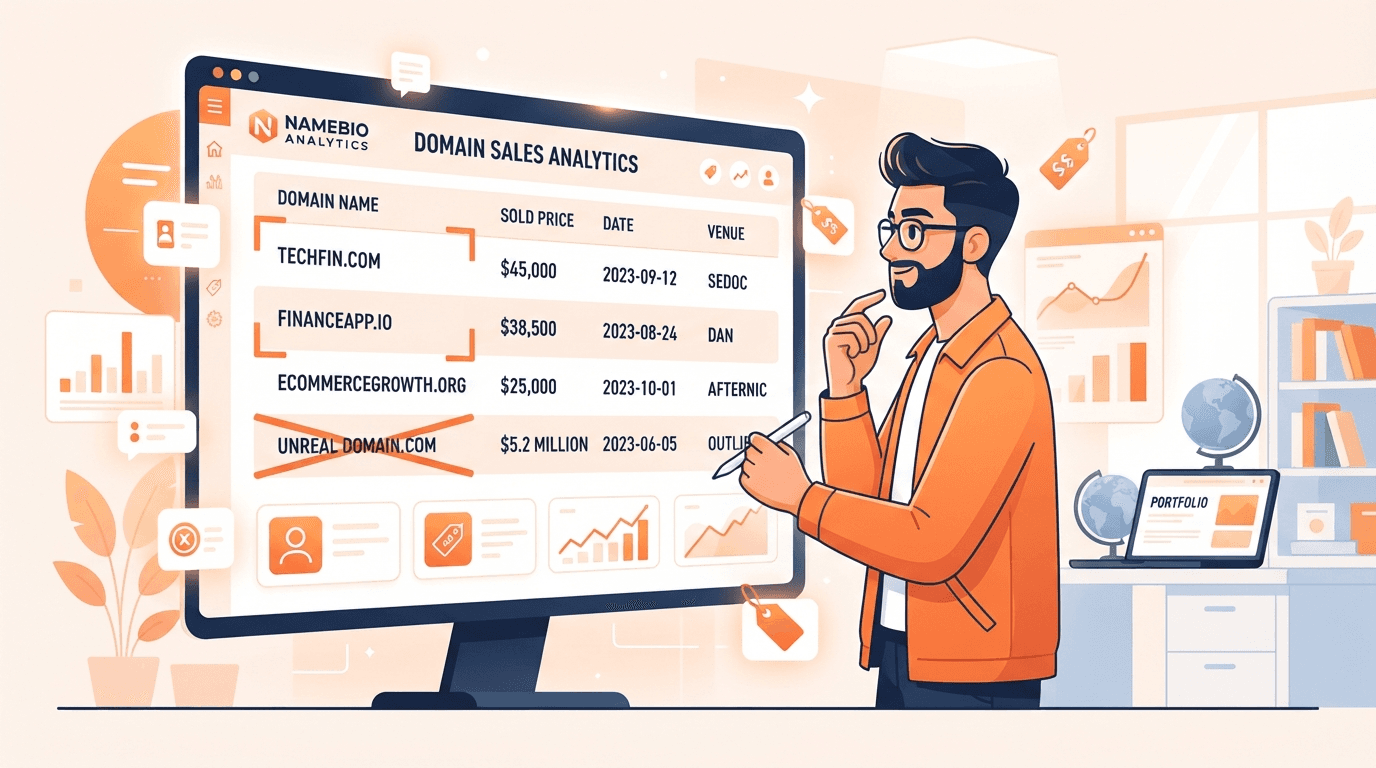
To price a domain with NameBio, search its reported-sales database for names that genuinely match yours on length, TLD, and style, filter to the last 12–24 months, and pull three to five tight comparable sales. That cluster — not any single headline sale — is your price range. Then separate wholesale (auction/reseller) prices from end-user retail ones, take the conservative end, and work backward through your costs to a maximum bid. It’s the difference between pricing with evidence and pricing with vibes.
I’ve been buying and flipping domains for over twenty years, and the single habit that separates investors who make money from investors who just accumulate renewals is this one: they never name a price, or set a bid, without pulling comps first. NameBio is the free tool that makes that possible — a public record of what buyers have actually paid. Most guides stop at “search for similar names,” which is like telling someone to “just cook the steak.” This one walks the whole thing, including a full worked example and the part nobody covers: turning the number into a disciplined auction bid.
What is NameBio, exactly?
NameBio is a searchable database of reported domain sales — millions of transactions pulled from marketplaces, auction platforms, brokers, and public sale reports, going back well over a decade. When someone sells a domain and the price is disclosed, it tends to land here. That makes it the closest thing the domain world has to a comparable-sales record, the same way real estate agents price a house off what the neighbors’ houses actually sold for rather than what the owner wishes it were worth.
The reason comps matter more than any appraisal tool comes down to what they are: real money, real buyers, real dates. An automated appraiser is a model’s opinion; a comp is a fact. As I argue in how to value a domain name, comps do the heaviest lifting in any honest appraisal — the other factors just adjust the number up or down from what similar names have proven the market will pay. That’s also the yardstick I use when ranking the automated options in the best domain appraisal tools: the good ones show you their comps, the weak ones just hand you a number.
Is NameBio free, and what do you get if you pay?
The core sales search is free and doesn’t need an account — keyword, TLD, length, price and date filters over the whole reported-sales archive. That free tier is the entire tool for what this guide is about: pulling a handful of comps to make one buy-or-walk decision. Paid membership is aimed at people doing research at volume rather than pricing one name — deeper filtering, bigger result sets, exports, and API access.
The API tier is worth knowing about even if you never pay, because a few of its endpoints are open. NameBio’s published API documentation puts the comps engine, sales-history lookups, daily and top sales, and keyword trend stats behind authentication — but exposes retail keyword statistics, TLD extension statistics, and Verisign drop-order data for pending-delete domains with no auth at all. The docs also state plainly that API access is intended for established businesses integrating the data into an existing service, and that reselling the data isn’t permitted — so it’s a build-time integration, not something you’ll casually script against.
The one limitation to keep in mind
NameBio is a record of reported sales, and that word is carrying weight. Marketplaces and auction venues publish their results, so that end of the market is well covered; privately brokered deals often aren’t disclosed at all, or surface much later. The practical consequence isn’t that comps are unreliable — it’s that the data skews toward the transparent, mid-market end of the range you care about anyway, while the quiet six-figure end is under-represented. For pricing an aftermarket buy that’s the right bias to have. Just don’t read “no comps above $X” as proof the ceiling is $X.
How do you search NameBio for comparable sales?
The trick is matching your search method to the kind of name you have. A keyword name and a pattern name want completely different queries, and using the wrong one is why beginners come away thinking “there are no comps.” Here are the filters that matter and when to lean on each:
| Filter | Use it when… | Why it matters |
|---|---|---|
| Keyword | Your name contains a real word or phrase | Finds sales of the same term, plus plurals and synonyms you search next |
| TLD / extension | Always — set it every search | A .com sale says almost nothing about a .xyz price; match the extension |
| Character length | Your name is a pattern (LLLL, five-letter brandable) with no real word | Lets you comp by shape when there’s no keyword to search |
| Date | Every search — narrow to the last 12–24 months | The market moves; a 2019 price can badly misprice a 2026 name |
| Price range | Filtering out obvious outliers at either extreme | Keeps a single six-figure sale from skewing your read |
For a keyword name, start with the exact term filtered to .com, then run the plural, the singular, and the one or two strongest synonyms as separate searches — buyers don’t care whether you sell them “deal” or “deals,” so both belong in your pool. For a pattern name like a five-letter pronounceable .com or a four-letter LLLL, there’s no keyword to chase, so you comp by length and TLD and then eyeball the results for names with the same pronounceability. If you want to pull comps in bulk or wire them into a spreadsheet, NameBio also exposes a public API, but for a single buy-or-walk decision the free web search is all you need.
A worked example: pricing a real candidate
Theory is cheap, so let’s price something. Say a five-letter, pronounceable brandable — call it Ravio.com — is ending soon on the aftermarket and I’m deciding whether to bid. It has no dictionary meaning, so I comp by pattern: five letters, .com, pronounceable (CVCVC), last 24 months. Here’s the kind of cluster that comes back (illustrative, but this is exactly the shape of a real pull):
| Comparable | Price | Venue type | Use it? |
|---|---|---|---|
| Zovic.com | $1,150 | End-user marketplace | ✅ Close match |
| Bexon.com | $740 | End-user marketplace | ✅ Close match |
| Naviq.com | $610 | End-user marketplace | ✅ Close match |
| Kliphq.com | $180 | Auction (wholesale) | ⚠️ Wholesale floor |
| Quixotical.com | $28,000 | End-user marketplace | ❌ Outlier — not five letters |
Read the table the way I do. The three close end-user comps cluster around $600–$1,150 — that’s my retail range. The $180 auction sale isn’t a retail comp at all; it’s another investor buying wholesale, which is useful because it tells me roughly what the name costs to acquire, not what it sells for. And the $28,000 sale gets thrown out immediately: it’s a long dictionary word, not a five-letter brandable, and leaving it in would triple my estimate on a single irrelevant data point. One outlier left in the pool is how people talk themselves into overpaying.
So my honest read on Ravio.com: a conservative resale of around $600 (the low end of the retail cluster, because I price on the floor, never the dream), against a wholesale acquisition cost somewhere near that $180 auction comp. That gap is the whole opportunity — and now I can turn it into a bid.
How to read a comp without fooling yourself
A comp is only as good as your discipline in reading it. Four rules keep the number honest:
- Separate wholesale from retail. Sales at auction venues and drop-catch platforms are largely reseller-to-reseller — wholesale prices. End-user marketplaces skew retail. A $200 auction sale and a $900 marketplace sale of near-identical names aren’t a contradiction; they’re the buy price and the sell price of the same kind of asset.
- Weight recent, ignore ancient. Read the last year or two. A headline sale from 2018 tells you about a market that no longer exists, and appreciation (or a cooled niche) can move a category a lot in a few years.
- Throw out the outliers. The single record-breaking sale in your results is almost always a special situation — a two-letter name, a corporate acquisition, a keyword in a white-hot niche. Price off the cluster, not the ceiling.
- Match style, not just length. Two five-letter .coms can be worlds apart: a smooth, sayable CVCVC versus an all-consonant jumble. Comp pronounceable names to pronounceable names — the trait that drives brandable value has to match too.
Turning comps into a maximum bid
A price range is academic until it produces a number you’ll act on. Your resale estimate is not your bid — your bid is what’s left after you subtract every cost and the profit you want. Back to Ravio.com, priced conservatively at $600 resale:
- Start from the conservative resale — $600, the low end of the retail cluster.
- Subtract the profit margin you require. I want at least a 3× return on a speculative flip, so I’m working toward an all-in cost near $200.
- Subtract acquisition costs. On the Namecheap Market you pay a 10% buyer’s premium on the winning bid plus the first-year registration (per Namecheap), and you’ll renew every year you hold the name. Budget roughly $25–$35 for premium plus registration on a bid this size.
- What remains is your true maximum — here, a ceiling around $165–$175, which lines up neatly with that $180 wholesale comp. Decide the number before the auction and treat it as final.
Two habits protect that number. Enter an odd, non-round max — $167 quietly edges out the crowd clustered on $150 — and never raise it in the heat of a close. Because proxy bidding only ever lifts you one increment above the next bidder, a disciplined max usually wins for less than the ceiling. The full mechanics live in Namecheap Market fees explained and how to snipe Namecheap auctions; the point here is that the comp is the bid, once you run it through your costs. If you want the ceiling-setting step on its own, with the increment behaviour and the odd-number logic worked through properly, that’s setting a maximum bid strategy.
What to do when NameBio comes up empty
Sometimes you search and there’s just… nothing close. Before you assume the name is either priceless or worthless, widen carefully: search the singular and plural, the strongest synonyms, and — for a multi-word name you’ll rarely find sold verbatim — comp the structure instead (two-word .com sales in the same category). If after all that you still can’t assemble three or four real comps, the absence is itself the signal: a name with no comparable sales usually has a thin buyer pool, and thin liquidity means you price conservatively and bid low, not high. No comps is a reason for caution, not for optimism.
Where NameBio fits in the hunt
Comps are the last gate before a bid, not the first. Upstream, you filter for structure (short or brandable, clean .com, no numbers or hyphens), screen the history for a spammy or penalized past, and only then pull comps to set a price and a max on the survivors. Done by hand, that’s a couple of focused minutes per name — fine for the three names you love, impossible for the thousands that hit their ending window every day on the Namecheap Marketplace.
That volume ceiling is exactly why I built PounceDomains. It connects to your own Namecheap account through the official Auctions API, applies your structural filters to every ending-soon auction, enriches the survivors with data (comps, appraisal signals, and a suggested max bid), and scores each one with AI so your attention only goes to names that can actually flip. NameBio is where you learn to read a comp; PounceDomains is what runs that read around the clock so you never miss a mispriced name because you were asleep when it closed.
The bottom line
NameBio turns domain pricing from a feeling into a defensible range. Match your search to the name, filter to the last year or two, pull three to five tight comps, separate wholesale from retail, throw out the outliers, and price on the conservative end. Then run that range through your costs — the 10% premium, registration, renewals, and the margin you need — to land on a maximum bid you set once and never chase past. Do that on every name and your wins stop being luck. Start free and let the comps and the bidding run themselves across the Namecheap aftermarket. For the wider appraisal framework the comps plug into, see how to value a domain name.
Frequently asked questions
How do you use NameBio to find comparable sales?
Go to namebio.com and search the way that matches your name. For a keyword name, type the keyword and filter to the .com extension; for a pattern name (a five-letter brandable, an LLLL), search by character length and TLD instead. Then narrow with the date filter to the last 12–24 months so you're reading the current market, not a boom five years ago. Sort by date, skim past the record-breaking outliers, and pull three to five sales that genuinely match yours on length, TLD, and style. That cluster — not any single sale — is your price range. The whole search takes a couple of minutes once you know which filter fits the name.
Are NameBio comps reliable for pricing a domain?
They're the most reliable input you have, but they're a range, not a verdict. NameBio aggregates publicly reported sales, so it reflects real transactions rather than an algorithm's guess — which is exactly why comps beat any single appraisal tool. The catches are honest ones: reported sales skew toward names that actually sold (you don't see the ones that sat unsold), some venues report wholesale reseller prices while others report end-user retail, and a name with few close matches gives you a wide, uncertain range. Read three to five tight comps, weight recent ones, separate wholesale from retail, and treat the result as a defensible range you can price and bid against.
Is NameBio free to use?
Yes. NameBio's core sales-search — keyword, TLD, length, price, and date filters over millions of reported domain sales — is free and doesn't require an account, which is why it's the default comp source for most investors. It also offers paid tiers and a programmatic API for heavier research and bulk exports, but for a buy-or-walk decision on a single name the free search is all you need. You're pulling a handful of comps to set a range, not running a data-science project.
Does NameBio have every domain sale?
No — it's a record of publicly reported sales, and that distinction matters when you read a range. Marketplaces and auction venues publish their results, so that end of the market is well covered; privately brokered deals are often never disclosed, or surface much later. In practice the data skews toward the transparent, mid-market end of the market — which is exactly the end you're transacting in on the aftermarket, so it's the right bias for pricing a buy. Just don't read an absence of comps above a certain price as proof that's the ceiling; it may only mean the sales above it were private.
How many comparable sales do you need to price a domain?
Three to five tight comps is the sweet spot — enough to see a cluster, few enough that each one is genuinely similar. One sale is an anecdote and could be an outlier; twenty loose matches just add noise. If you can find only one or two real comps, widen the search carefully (plurals, close synonyms, the same pattern) before you loosen your standards, and if you still can't find a cluster, treat the name as illiquid and price it conservatively. No comps at all isn't a reason to guess high — it's usually a sign the buyer pool is thin.
Mark Fulton
Developer & Founder of PounceDomains · 20+ year domain investor
Mark Fulton is a 20+ year domain investor and the developer and founder of PounceDomains. He has spent two decades buying, building, and flipping domain names, and built PounceDomains himself to automate the hunt for undervalued domains on the Namecheap aftermarket.
Keep reading
Short Domain Names: Where Length Stops Paying (2026)
Are short domain names better? A 20-year investor's length-vs-value ladder — the scarcity math, the six-character crossover where length stops paying, and the tradeoffs.
Dictionary Word Domains: Real Words, Real Demand (2026)
Are dictionary word domains valuable? A 20-year investor's category value ladder — which real words hold demand, which don't, and how to catch one on the aftermarket.
Snipe these domains automatically
PounceDomains watches Namecheap Market 24/7, scores every ending-soon domain with AI, and bids on the winners. Free to start.
Start sniping free