
Best Domain Drop Catching Service (2026 Comparison)
What's the best domain drop catching service in 2026? A 20-year investor compares DropCatch, SnapNames, Dynadot and PounceDrops on fees, catch rates, and fit.
 Mark FultonJul 9, 12:00 AM UTC10 min read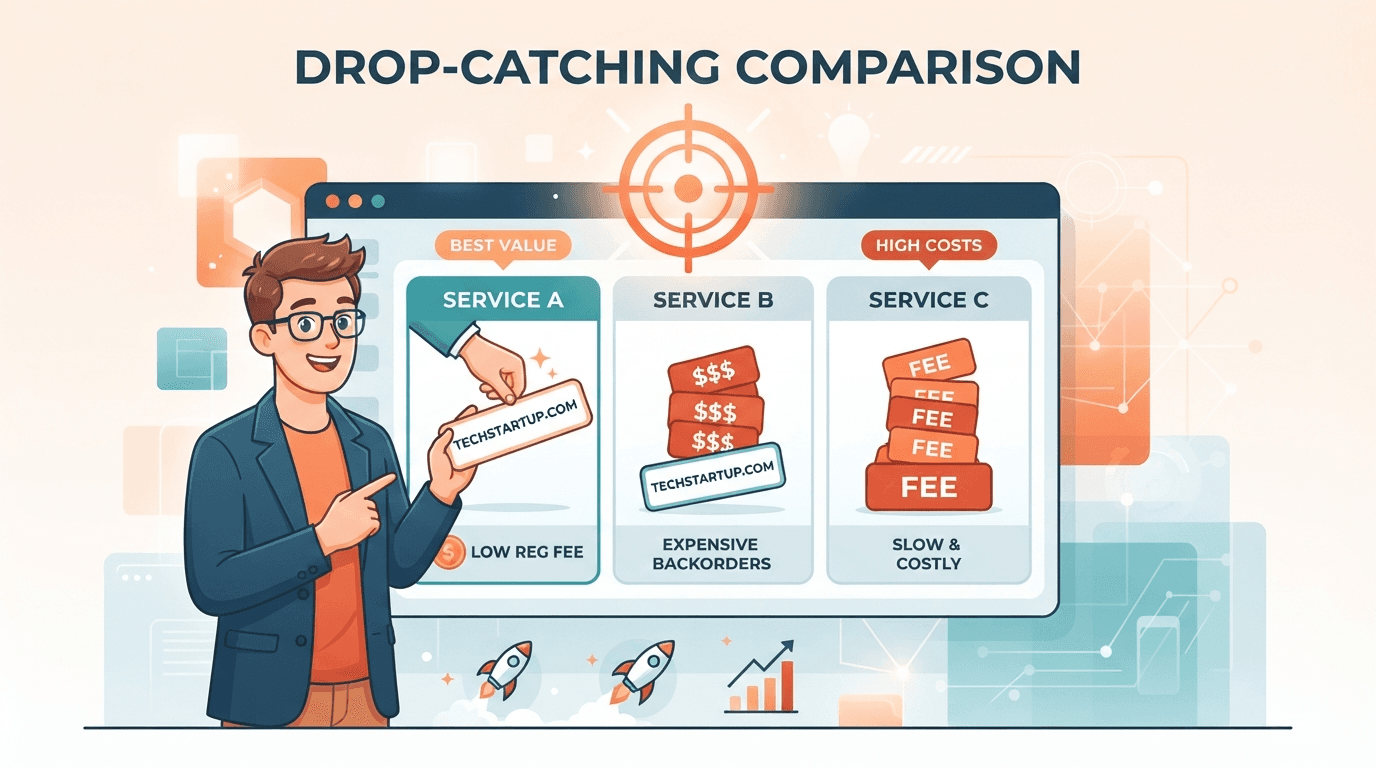
There is no single “best” domain drop catching service in 2026 — there are two jobs, and the right tool depends on which one you’re doing. For a heavily contested premium name that a dozen investors are all chasing, a large catch network like DropCatch or SnapNames — firing registration attempts across more than a thousand registrar connections — still gives you the best raw odds. But for the daily long tail (the thousands of genuinely good names that quietly drop with nobody racing for them), the best value today is a service that catches at the standard registration price and tells you which drops are actually worth the money. That’s the lane PounceDrops is built for.
I’ve been buying and flipping domains for more than twenty years, and I’ve fed target lists into just about every catch service that has come and gone. Here’s the thing the “best drop catcher” listicles never tell you: most of them are ranking the same infrastructure for the same job — winning contested trophy names — and they judge it almost entirely on catch rate. Catch rate matters, but it’s one variable of five, and for the way most investors actually make money (buying undervalued names to flip), it isn’t even the one that decides your profit. Let me lay out the whole landscape honestly, give you a real comparison table, and then tell you which service fits which investor.
What “best” actually means in drop catching
Before you can rank services, you have to agree on what you’re ranking them for. After two decades I judge every drop catcher on five things, roughly in the order they hit your wallet:
- Catch rate. When a name you want drops, what are the odds this service is the one that grabs it? This is driven almost entirely by how many registrar connections it can fire from at the instant of deletion.
- Cost model. Not the headline fee — the all-in cost. A backorder fee, whether or not it’s refundable, plus any monthly membership, plus (this is the big one) the private auction that fires when more than one customer wanted the same name.
- Whether it tells you what a name is worth. Catching a name is worthless if it’s junk. Most services hand you raw metrics and leave the appraising to you — which, across hundreds of drops a week, is the actual work.
- Where the name lands. Some services catch into their own account and make you transfer the name out afterward; others register straight into an account you already control.
- What inventory it can even see. Some services only work the pending-delete lists everyone already has; a few build their own.
If you only look at catch rate, you’ll conclude the biggest network wins and stop there. Look at all five and the picture splits cleanly in two, which is exactly why the honest answer to “what’s best” is “best at what?”
The drop-catching landscape in 2026
Drop catching means registering a domain the instant it’s deleted from the registry and released back to the public pool. An expiring name walks a fixed lifecycle first — an auto-renew grace period, a redemption grace period, then a ~5-day pending-delete window (the ICANN Expired Domain Deletion Policy) — and only when pending delete ends does it actually drop. Catching is the race to re-register it in the milliseconds after that release. If you’re fuzzy on how that differs from bidding on a name in an auction, I break it down in domain drop catching vs. auctions. Here’s who competes for that moment in 2026:
- The big catch networks — DropCatch and SnapNames/NameJet. These are the heavyweights. DropCatch is generally credited with the largest catch infrastructure (over a thousand registrar accreditations), which is why it wins so many contested drops. SnapNames and NameJet share inventory and lean toward curated premium expired names sold through private auctions. This is the tier to reach for when you need one specific trophy .com and are willing to fight for it. (For what that shared inventory means in practice, see what a NameJet alternative can and cannot replace.) The two work very differently, and DropCatch vs NameJet traces one name through both.
- Registrar backorders — Dynadot and friends. Some registrars bolt a budget backorder onto their platform. Dynadot is the well-known one: free to place, charged only on a successful catch, and decent for less-contested names, but with a far smaller catch footprint than the dedicated networks and a public backorder auction the moment two people want the same name (see why a free Dynadot backorder isn’t a cheap one). Note that GoDaddy has stepped back from standalone backordering, thinning this tier further.
- Data and list tools — ExpiredDomains.net, Spamzilla. These aren’t catchers; they’re where investors find drop candidates and their SEO history. You still need a catch service to actually land anything they surface.
- The newer lane — AI-valued, registration-price catching. This is where PounceDrops sits. Instead of racing thousands of registrars for trophy names, it works the daily long tail: it watches names through pending delete, values each one with AI, and registers the winners through your own Namecheap at the standard price. Different job, different economics.
Drop catching services compared, side by side
This is the table the “best drop catcher” roundups gloss over, because it puts cost model and who appraises the name next to catch rate instead of hiding them. Read the “What it costs” and “Picks winners for you” columns first — that’s where the money actually leaks. Fees move around, so treat the cost column as representative of each model rather than a live quote; always confirm current pricing on the service itself before you commit.
| Service | What it costs | Catch-rate edge | Picks winners for you | Best for |
|---|---|---|---|---|
| DropCatch | Membership tiers plus a per-name catch fee; contested names go to a private auction on top | Highest — 1,000+ registrar connections | No — raw metrics, you appraise | Contested premium .com you must have |
| SnapNames / NameJet | Per-name backorder fee (roughly $20–$80, sometimes refundable); private auction if contested | High — shared premium inventory | No — curated lists, you appraise | Curated premium expired names |
| Dynadot backorder | Free to place; pay only on a successful catch | Modest — small registrar footprint | No | Budget attempts on low-contention names |
| PounceDrops | Standard registration price — no catch fee, no auction; included with Elite | Long-tail focused — not a thousand-registrar race | Yes — AI valuation on every candidate | The daily long tail nobody else is chasing |
The row that surprises newcomers is the cost model, not the catch rate. When a backorder service catches a name that two of its customers wanted, it doesn’t just hand it to one of you — it runs a private auction between you, so the “$59 catch” you budgeted for can settle for hundreds or thousands. That’s fine when the name is a genuine trophy worth fighting for. It’s a terrible model for the bread-and-butter flip, where your entire margin is the gap between what you paid and what you sell for.
How to choose the best drop catcher for you
Match the service to the situation, not the other way around. Four common scenarios, four different answers:
- You want one specific, contested premium name. Go to the big networks — DropCatch first, and backorder at a second network too. Accept the private-auction risk; for a trophy name it’s the price of the best odds, and nothing you run through a single account will beat a thousand-registrar race.
- You’re buying undervalued names to flip, at volume. The trophy-name economics work against you here. You want the long-tail lane: catch at registration price so your margin survives, and let something else do the appraising so you’re not hand-scoring hundreds of drops a week.
- You’re chasing SEO domains with backlink history. Pair a data tool (ExpiredDomains.net, Spamzilla) with a catch service — but run a hard expired-domain filter first so you’re not catching a penalized past dressed up as authority.
- You just want good names cheaply, without babysitting a calendar. This is the sweet spot for an automated, AI-valued catcher. You add names to a watchlist, it tracks the delete lifecycle for you, and it catches the worthwhile ones at the standard price.
Notice that only the first scenario actually rewards the “biggest network” that the roundups crown. The other three — which is where most investors spend most of their budget — reward a completely different set of strengths.
Why PounceDrops is the best value for the long tail in 2026
I’ll be straight about what PounceDrops is and isn’t, because the honesty is the point. It is the standalone drop-catching companion app included with the PounceDomains Elite plan (and every new account’s 14-day trial), and it’s built to win the daily long tail rather than the trophy drops. Here’s where it beats the traditional services on the five criteria that matter:
- It catches at registration price. There’s no $20–$80 backorder fee and no auction premium. When a watched name drops, PounceDrops registers it through your own connected Namecheap account at Namecheap’s standard price — the same price you’d pay to hand-register anything. On the long tail, that gap is the profit.
- It tells you what’s worth catching. Every watched name gets an AI valuation against real aftermarket comps, its age, and its history, so the handful of keepers stand out from the flood. This is the appraising the big networks leave entirely to you. (If you want the manual version of that judgment, it’s in how to value a domain name.)
- It watches the lifecycle so you don’t. PounceDrops re-checks each name’s availability via RDAP (the registration data protocol that replaced legacy WHOIS) every five minutes through the delete lifecycle, so a name that frees up gets caught fast without you tracking pending-delete dates by hand.
- It registers into your account, and never overspends. Names land in your own Namecheap from the start — nothing to transfer out. And premium-flagged drops are never auto-registered: if a name comes back priced as a premium registration, you get an alert to decide rather than a surprise charge.
- It covers inventory the others don’t. Beyond the NameJet and pending-delete lists you bring, PounceDrops builds its own daily list of dropping
.devand.appnames by diffing the registry zone files (via ICANN CZDS) and confirming pending delete over RDAP — a whole category the traditional catchers don’t surface a real list for.
And the honest limit, stated plainly: for a heavily contested premium name that dozens of investors are racing for, a dedicated thousand-registrar catch network will usually out-race a single Namecheap connection. Use those services for the trophies. PounceDrops is built to win everything else — the enormous daily long tail of good names dropping with nobody watching — at registration price, and to tell you which of them are actually worth registering. You can open PounceDrops directly or see the full walkthrough on the drop catching page.
The honest bottom line
“What’s the best domain drop catching service?” is really two questions wearing one coat. If you need a specific contested trophy name, the best service is whichever big network can spread the most registrar attempts across the drop — DropCatch leads that pack, and doubling up at SnapNames/NameJet improves your odds (if you’re weighing that decision, see what a DropCatch alternative actually replaces, and where a SnapNames win actually lands before you open a second account, and what to use now that GoDaddy has retired backorders if that is the service you lost). If you’re doing what most investors do — acquiring undervalued names to flip — the “best” service isn’t the one with the highest catch rate on names you’ll never chase; it’s the one that keeps your cost at the registration price and does the appraising for you so your attention only goes to names that can genuinely turn a profit. On that job, in 2026, an AI-valued, registration-price catcher wins — and it’s the reason we made PounceDrops the centerpiece of the Elite plan, with every new account’s 14-day trial included so you can prove it to yourself first. Start your free trial, connect your Namecheap key, and let the drops come to you.
Frequently asked questions
What is the best domain drop catching service in 2026?
There's no single winner — it depends on the job. For a heavily contested premium .com that dozens of investors are chasing, a large catch network like DropCatch (which fires registration attempts across more than a thousand registrar connections) gives you the best raw odds. For the daily long tail — the thousands of good expired and pending-delete names that quietly drop with nobody racing for them — the best value in 2026 is a service that catches at Namecheap's standard registration price and tells you which drops are actually worth registering. That's the gap PounceDrops fills: an AI valuation on every candidate, RDAP monitoring through the delete lifecycle, and auto-registration into your own Namecheap account with no backorder or auction fee.
How much do domain drop catching services charge?
Most charge a backorder fee per name, framed either as a flat fee or a subscription. Across the major services in 2026 that fee typically runs from roughly $20 to $80 per name — some refundable if the catch fails, some not — and the big networks also sell monthly membership tiers for higher priority. The bigger cost surprise is contention: when two or more customers backorder the same name and the service catches it, it usually resells the name in a private auction between them, so a headline '$59 catch' can settle for hundreds or thousands. PounceDrops works differently — it registers a dropped name through your own Namecheap account at the standard registration price, with no catch fee and no auction premium, and it's included with the PounceDomains Elite plan (and every new account's 14-day trial).
Is DropCatch or SnapNames better for drop catching?
They're the two heavyweight catch networks and they overlap heavily — SnapNames shares inventory with NameJet, and both run private auctions on contested premium names. DropCatch is generally regarded as having the largest catch infrastructure (over a thousand registrar accreditations), which helps most on hotly contested drops; SnapNames and NameJet lean toward curated premium expired inventory and private auctions. For a specific trophy name, backordering it at more than one network improves your odds. For volume flipping of undervalued names, neither is really built for the daily long tail — that's where an AI-valued catcher like PounceDrops changes the economics.
Can you catch dropping domains at registration price?
Yes, and it's the single biggest lever on drop-catching profit. Traditional backorder services charge a catch fee (and often an auction premium) on top of the registration, so your all-in cost lands well above the standard price. PounceDrops registers a dropped name through your own connected Namecheap account at Namecheap's standard registration price — no backorder fee, no auction. The trade-off is honest: for a heavily contested premium name a thousand-registrar catch network will usually out-race a single Namecheap connection, so registration-price catching wins on the enormous daily long tail, not the handful of trophy drops.
Mark Fulton
Developer & Founder of PounceDomains · 20+ year domain investor
Mark Fulton is a 20+ year domain investor and the developer and founder of PounceDomains. He has spent two decades buying, building, and flipping domain names, and built PounceDomains himself to automate the hunt for undervalued domains on the Namecheap aftermarket.
Keep reading
DropCatch vs NameJet: Two Very Different Ways to Catch a Drop
DropCatch vs NameJet in 2026: one races the registry, the other sells access before the race. Fees, auction rules and deadlines read on the day, plus a verdict.
GoDaddy Backorder Alternative: What Replaced a Dead Product
GoDaddy retired backorders in 2025. A 20-year investor on why Auctions is not a like-for-like swap, and which alternative fits the name you are actually chasing.
Snipe these domains automatically
PounceDomains watches Namecheap Market 24/7, scores every ending-soon domain with AI, and bids on the winners. Free to start.
Start sniping free