
Best Domain Investing Platforms (2026): An Honest Map
The best domain investing platforms in 2026, mapped by a 20-year investor to the stage each one actually covers — with real commission numbers and the gap nobody fills.
 Mark FultonAug 9, 12:00 AM UTC10 min read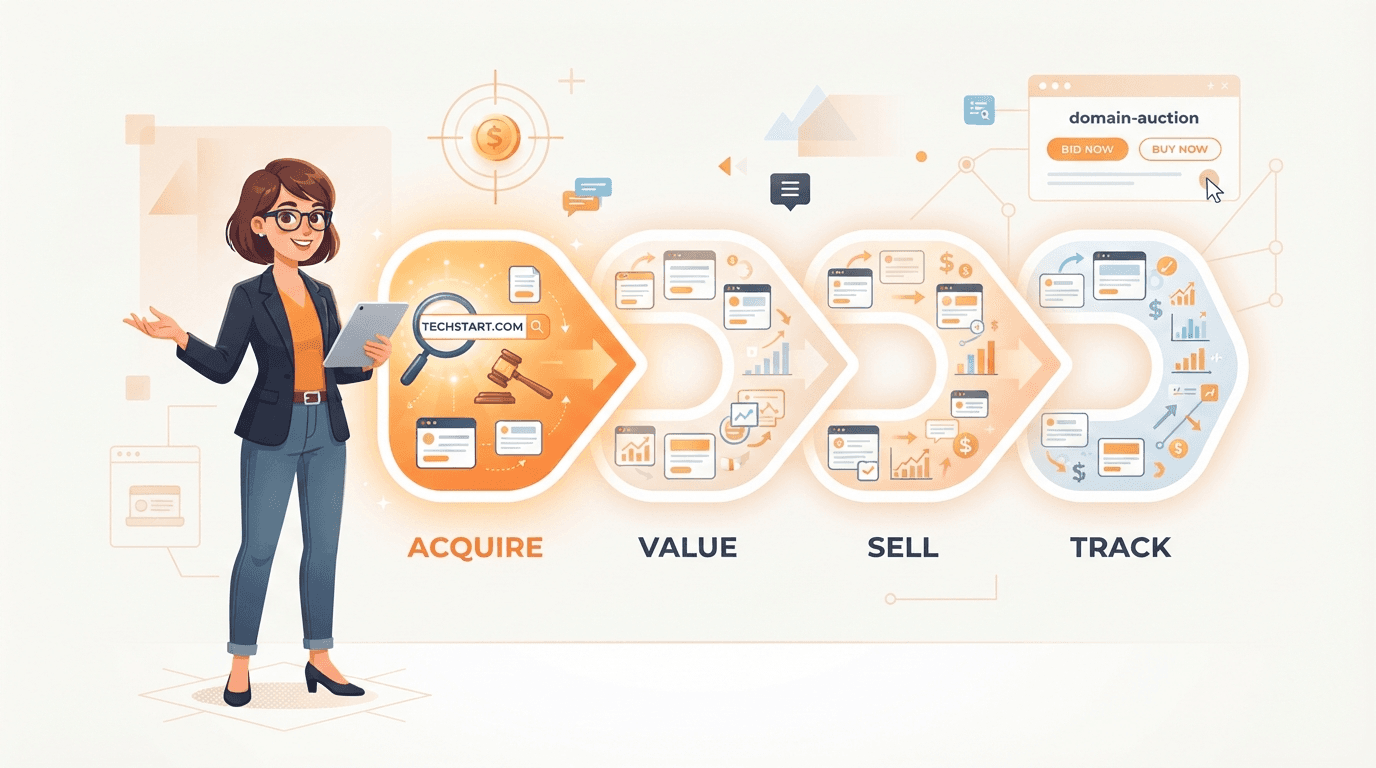
Almost every “best domain investing platforms” list is really a list of places to sell domains, and that is only half the business. Domain investing is a four-stage loop — acquire, value, sell, track — and the platforms in this category cluster hard on the last two. Sedo and Afternic are distribution. Efty is portfolio infrastructure. Spaceship is a cheap registrar with a fast-growing sales layer. Every one of them is good at its stage, and not one of them will find you an undervalued name to buy. Your profit is decided at acquisition, so build a stack that covers the whole loop rather than three tools that all cover the same corner of it. After 20+ years of buying and flipping names, that gap is the single most expensive thing I see new investors miss.
The roundups you have already read make this hard to notice. The largest one I could find lists nine marketplaces with pros and cons and does not publish a single commission rate anywhere in 2,500 words. Others do publish a fee table, but every platform in it is a selling venue, so the table quietly defines “domain investing” as “listing.” This piece does the thing none of them do: maps each platform to the stage of the loop it actually covers, with real 2026 numbers, and is honest about the stage where the whole category — mine included — leaves you on your own.
What actually counts as a domain investing platform?
Four different kinds of product get filed under this label, and collapsing them is why the comparisons are so unhelpful. There are marketplaces (Sedo, Afternic), which are distribution networks that put your listing in front of buyers you could never reach yourself. There are portfolio managers (Efty), which give you landing pages, your own checkout, and a ledger of what your names cost you. There are registrars with a sales layer (Spaceship, Dynadot, Namecheap), where your names live and can also be listed. And there are acquisition tools — the smallest and least-covered group — which help you find and buy names in the first place.
Those are not competitors with each other. A marketplace and a portfolio manager solve different problems and most working investors run both. The useful question is never “which platform is best?” but “which stage am I currently doing badly, and what covers it?”
What is each platform genuinely best at?
Here is the honest map. I have named what each one does better than anyone else, because a table where a single product wins every row tells you nothing. Commission rates in this category repriced twice in the last year, so treat every figure as “as of August 2026” and confirm on the vendor’s own page before you commit.
| Platform | Type | Genuinely best at | Where it falls short |
|---|---|---|---|
| Sedo | Marketplace | Global reach and European ccTLDs; deep brokerage for high-value names | Higher commissions; slow-moving interface; nothing on the buy side (Sedo alternatives) |
| Afternic | Marketplace | Reseller distribution at registrar checkouts — the widest net for generic keyword .coms | Top-of-band commission; you are one listing among millions (Afternic alternatives; where Dan.com sellers went) |
| Efty | Portfolio manager | Own-branded landing pages, your own checkout, and real P&L visibility at low commission | Monthly fee only pays off at scale; brings you no buyers of its own (Efty alternatives) |
| Spaceship | Registrar + sales layer | Cheap renewals and a genuinely modern selling flow; good place to hold inventory | Young marketplace with less buyer traffic; commission already doubled once (Spaceship compared) |
| GoDaddy / Auctions | Registrar + marketplace | Largest expiring inventory anywhere and the biggest buyer audience | No public bidding API for investors; retired standalone backorders in 2025 |
| PounceDomains | Acquisition tool | Around-the-clock discovery, AI scoring and enrichment on live Namecheap Market auctions, with a suggested max bid | Namecheap Market only; does not sell, list, or broker anything |
Which stage of the loop does each platform cover?
This is the table the other roundups do not have, and it is the one that shows you what you are missing. Read down the Acquire column first.
| Platform | Acquire | Value | Sell | Track |
|---|---|---|---|---|
| Sedo | No | Partial | Strong | Partial |
| Afternic | No | Partial | Strong | Partial |
| Efty | No | No | Strong | Strong |
| Spaceship | No | No | Partial | Partial |
| GoDaddy Auctions | Partial | Partial | Strong | No |
| PounceDomains | Strong | Strong | No | Partial |
The pattern is the whole point. Four of the six best-known “domain investing platforms” score nothing at all on acquisition, and the one venue that does — GoDaddy Auctions — only gets a partial because raw inventory without filtering leaves you scrolling a firehose by hand. Meanwhile the sell column is crowded with strong entries competing over a few percentage points of commission.
That is backwards relative to where the money is made. You cannot fix a bad purchase with a good listing: if you overpay at auction, the best marketplace on earth just sells your mistake more efficiently. Buying below resale value is the entire margin, which is why I treat finding undervalued expired domains as the skill that decides whether the rest of the loop is worth running.
What do these platforms actually cost you?
Commissions run from about 5% to 25%, and the spread tracks how much buyer attention the platform supplied — not how good the software is. That framing makes the numbers easy to judge.
At the low end, Efty Pay charges 5%, per DomainInvesting.com’s February 2026 commission breakdown, and it is low precisely because you brought the buyer to your own landing page. Spaceship sits at 10%: Domain Name Wire reported that SellerHub doubled its commission from 5% to 10% in February 2026, with checkout and self-serve links staying at 5%. The distribution networks charge most — Sedo and Afternic generally land in the 10–20% band depending on sale type and value, with syndicated network sales at the top.
Two things follow. First, a high commission is often worth paying: 20% to a network that found a buyer you never could is a better deal than 5% on a sale that never happens. Second, the commission is not your main cost. Renewals are. A name you carry for four years before it sells has quietly cost you four registrations, and that number dwarfs the percentage difference between venues on an ordinary flip — which is the arithmetic behind the renew-or-drop discipline in domain portfolio strategy.
The buy side has its own fee stack that the platform comparisons never mention. On the Namecheap Market that means a 10% buyer’s premium on your winning bid, the first year’s registration, and the subscription and account minimums set out in Namecheap’s Auctions Bidding Guide — a Market subscription at $5 per year and a $100 minimum account balance to bid at all, rising to $1,000 in funds for any bid of $10,000 or more. That guide also notes you may not decrease a maximum bid once placed, which is exactly why the number goes in a max-bid worksheet before the clock is running. The full breakdown lives in Namecheap Market fees explained.
What is missing from every platform on this list?
A reason to act today. Every sell-side platform is patient by design — your listing sits there until a buyer arrives, and nothing is lost by checking in next week. Acquisition is the opposite. Names close on a schedule, and on the Namecheap Market the daily batch closes together at 11:00 AM ET, so a name you meant to research is simply gone. A platform with no clock cannot help you with a job that is entirely about one.
The second gap is judgment at volume. Thousands of names move through the aftermarket every day and the handful worth owning are buried among hyphenated junk and dead new extensions. Sorting that by hand is the real bottleneck for most investors, and no marketplace dashboard addresses it — they are built for the names you already own. The research layer that does exist is covered in the domain sniping tools roundup, and the valuation layer in best domain appraisal tools — though an appraisal without a live auction attached to it is a number for a name nobody is selling.
I will be straight about where my own product sits, because a roundup that ends in a pitch deserves skepticism. PounceDomains covers acquire and value, and nothing else. It does not list, sell, broker, or hold your names, and it is single-venue by design — the Namecheap Market, not GoDaddy, not the wider drop market, which is a real limitation and not a positioning choice I am going to dress up. What it does is watch that market around the clock, AI-score and enrich every ending-soon candidate against configs you set yourself, surface the drops that close with no bids, and hand you a conservative resale range with a suggested max bid while the name is still biddable. If your names expire somewhere other than Namecheap, you want a drop-catching service instead.
How should you build your stack?
Assign every tool to a stage, and refuse to pay twice for the same one. Three sketches of what that looks like in practice:
Starting out, under about 25 names. A spreadsheet for tracking, one marketplace listing for reach, and all of your remaining attention on acquisition. Do not buy a portfolio manager yet — you do not have a portfolio, you have a few names, and the monthly fee is better spent on a better name. Price everything against real comparable sales before you bid.
Growing, 25 to a few hundred names. This is where tracking genuinely starts failing and a portfolio manager earns its fee, and where listing on more than one venue starts to matter. Pick venues by where your buyers are rather than by commission alone — the venue map is in where to sell domains. Add a real acquisition channel here too, because at this size your renewals are large enough that mediocre buying compounds against you.
At scale. Own the buyer relationship through your own landing pages and checkout to cut commission, keep the distribution networks for reach on names that need it, and automate acquisition because attention, not budget, is now your constraint. The economics of the whole loop are in how to make money flipping domains.
Whichever stage you are at, run the test that this article is really about: write down your four stages and name the tool covering each one. If acquire is blank, that is not a gap in your toolkit — it is the stage where your returns are actually decided, and no amount of listing-side polish will make up for it. If the blank is on the Namecheap aftermarket specifically, that is the gap I built PounceDomains to fill, and you can start a free account and have a config running in a couple of minutes.
Frequently asked questions
What is the best platform for domain investing?
There isn't one, and the reason is structural rather than a cop-out: no platform in this category covers the whole job. Domain investing is a four-stage loop — you acquire a name, you value it, you sell it, and you track what it costs you in the meantime — and almost every product marketed as a "domain investing platform" is really a selling venue with a dashboard attached. Sedo and Afternic are distribution: they put your name in front of buyers you could never reach alone. Efty is portfolio infrastructure: landing pages, your own sales flow, and a low commission because you brought the buyer. Spaceship is a cheap registrar with a fast-growing sales layer. All of those are sell-side tools, and they are genuinely good at that half. The half they leave to you is acquisition — finding an undervalued name and buying it below resale value — which is where your actual profit is decided. Pick your selling venue by where your buyers are, then solve acquisition separately, because no listing platform is going to do it for you.
How much commission do domain selling platforms charge?
Between about 5% and 25%, and the spread tracks how much of the buyer's attention the platform supplied rather than how good the software is. At the low end, Efty Pay charges 5% — DomainInvesting.com's February 2026 commission breakdown quotes exactly that figure, and it is low precisely because you drove the buyer to your own landing page. Spaceship's SellerHub sits at 10% after doubling its rate: Domain Name Wire reported in February 2026 that it moved from 5% to 10%, with checkout and self-serve links staying at 5%. The distribution networks charge most — Sedo and Afternic generally land somewhere in the 10–20% band depending on sale type and value, and syndicated network sales sit at the top of that range. Verify current rates on each vendor's own page before you commit, because this category repriced twice in the last year alone. The right way to read the number is as payment for reach: if the platform found your buyer, a high commission is usually worth it, and if you found the buyer yourself, you should not be paying one.
Where do domain investors actually buy domains?
Overwhelmingly on the aftermarket, not by hand-registering ideas — and this is the part the platform roundups skip entirely. Every good short .com, dictionary word, and clean two-word pairing was registered decades ago, so the supply of quality names is really a flow of existing names whose owners stop renewing them. That flow surfaces in expiring-domain auctions at registrars like the Namecheap Market and GoDaddy Auctions, in drop-catch networks that race for names after full deletion, and in direct purchases from current owners. Almost none of the platforms sold as "domain investing platforms" participate in that side at all — Sedo, Afternic, and Efty are where names go to be sold, not where investors source them cheaply. The practical consequence is that your buying and your selling usually happen in completely different places, and the buying side is where you should spend your attention, because a name bought badly cannot be rescued by a good listing.
Do you need more than one domain platform?
Yes, and two or three is the normal working stack rather than a sign you have over-complicated things. The reason is that the stages genuinely don't overlap: a marketplace with distribution reach cannot tell you which expiring auction is underpriced today, and a portfolio manager with beautiful landing pages does not surface a single acquisition candidate. A typical setup is one acquisition channel where you actually source names, one or two selling venues chosen by where your buyers are, and a tracking layer — which can be a spreadsheet until your portfolio is large enough to justify paying for one. What you should avoid is paying three subscriptions that all do the same job. Before you add anything, name the stage it covers and check you are not already covered there. If a tool cannot be assigned to a stage, you do not need it.
Is Efty worth it for a small portfolio?
Probably not at first, and Efty's own economics are the reason. Its low commission is the payoff for bringing your own buyer through your own landing pages, which means the value scales with how many names you hold and how much inbound traffic they generate — a handful of names produces very little of either, so you would be paying a monthly fee to save commission on sales that are not happening yet. For a small portfolio the honest answer is that a spreadsheet plus a marketplace listing covers you, and the money is better spent on acquiring better names. Efty starts making sense when you have enough inventory that manual tracking is genuinely failing, when renewals across the portfolio are large enough that carrying-cost visibility changes decisions, and when you are getting real inbound inquiries worth routing through your own checkout. That is a portfolio-size question, not a preference — and it flips for most investors somewhere in the low hundreds of names, not at twenty.
Mark Fulton
Developer & Founder of PounceDomains · 20+ year domain investor
Mark Fulton is a 20+ year domain investor and the developer and founder of PounceDomains. He has spent two decades buying, building, and flipping domain names, and built PounceDomains himself to automate the hunt for undervalued domains on the Namecheap aftermarket.
Keep reading
Dan.com Alternative: Where Its Sellers Went in 2026
Dan.com shut down on 27 June 2025 and its sellers were moved to Afternic. What survived, what was lost, and where to get each Dan feature back in 2026.
Afternic Alternative: What Its Reach Actually Costs
A 20-year investor on Afternic alternatives in 2026: the 30% default commission, the nameserver discount, the Fast Transfer eligibility gate, and when leaving pays.
Snipe these domains automatically
PounceDomains watches Namecheap Market 24/7, scores every ending-soon domain with AI, and bids on the winners. Free to start.
Start sniping free