
Domain Aftermarket Explained: Where the Deals Are
The domain aftermarket is five venues wearing one name. A 20-year investor maps who you are buying from in each, who sets the price, and where the deals hide.
 Mark FultonSep 9, 12:00 AM UTC8 min read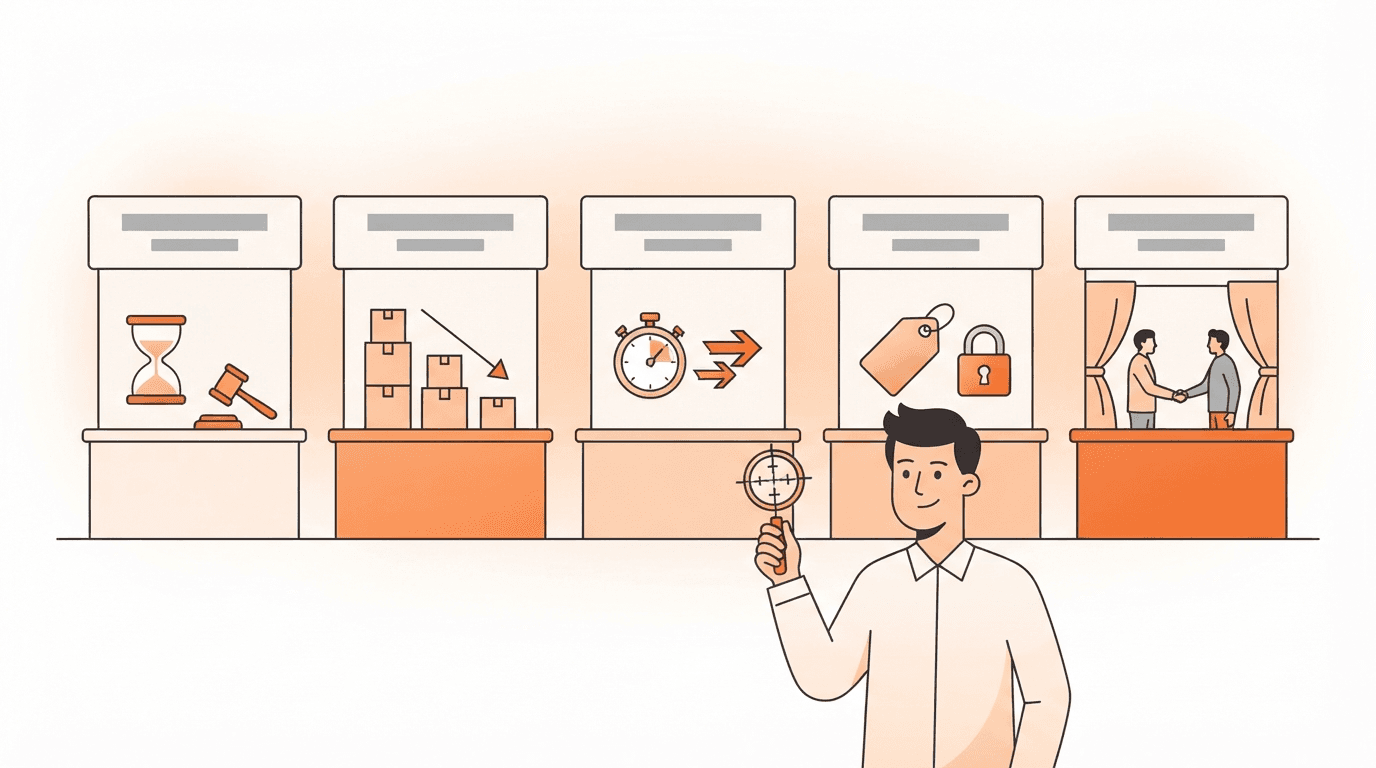
The domain aftermarket is the second-hand market for domain names — every venue where a name that is already registered changes hands instead of being created fresh at a registrar. That definition is correct and almost useless, because “the aftermarket” is one word covering at least five venues that behave nothing alike. They differ in who you are buying from, who sets the price, whether there is a deadline, and whether the seller has any reason to say yes. Treat them as one market and you will spend your budget in the most expensive lane of the five.
I have been buying and selling domains for over twenty years, and the aftermarket has never been a single place. It is a registrar clearing out abandoned inventory in one room and an owner holding out for six figures in the next, and both rooms get called the same thing. What follows is the map I actually use.
What is the domain aftermarket, exactly?
Start with the boundary. There are two ways to get a domain. The primary market is registration: the name has never been taken, you pay a registrar a registration fee, and it is yours. Everything else is the aftermarket. Once a name has been registered to somebody, any later change of hands happens second-hand, at a price somebody sets rather than a price on a menu.
The encyclopedia version stops roughly there. Wikipedia describes the domain aftermarket as the secondary resale market for names already registered, which is accurate and tells a buyer nothing about where to spend money. The part that matters is not the definition. It is that within the aftermarket there are two fundamentally different kinds of seller.
One is a registrar clearing inventory. Somebody stopped paying for a name, and the registrar now has a deadline-driven asset it would rather monetize than delete. It has no emotional attachment, no asking price, and a calendar. The other is an owner holding out. They still pay the renewal, they still control the name, and they have listed it at a number they invented. They can wait forever, because waiting costs them about ten dollars a year.
Every venue below is one of those two, and once you can tell which one you are standing in, the pricing stops being mysterious.
The five venues hiding inside one word
Here is the map. The column that does the work is the second one, because who you are buying from predicts everything downstream.
| Venue | Who you are buying from | Is there a deadline? | What it is good for |
|---|---|---|---|
| Expiring auctions Namecheap Market, GoDaddy Auctions, Dynadot and the rest. | A registrar clearing inventory. The previous owner has stopped paying and is not part of the conversation. | Yes, and it is published. Auctions typically run about a week and close on a fixed schedule. | The best risk-adjusted prices in the whole market, if you can sort the good names out of the volume. |
| Closeouts The lane that runs after an auction nobody bid on. | The same registrar, now visibly motivated. Nobody wanted this at auction and the clock is still running. | Yes, and the price falls as it runs. Each no-bid day steps the minimum down. | Cheap acquisition on names that are fine rather than exciting. Volume plays live here. |
| Backorders and drop catching Placed before the name is available at all. | Nobody, technically. You are buying a service’s attempt to register the name the instant the registry releases it. | Yes, but you do not control it. The registry sets the release moment. | Names you specifically want that never reach a public auction. It is an attempt, not a purchase. |
| Marketplace listings Buy Now and Make Offer inventory on the big platforms. | An owner holding out. They pay the renewal and they chose the number. | None whatsoever. The listing can sit for years. | Buying one specific name you actually need. Rarely an investment entry point. |
| Private and outbound You approach an owner who never listed anything. | An owner who was not selling until you asked, which is the weakest position a buyer can occupy. | None, and now they know somebody wants it. | End users acquiring a name the business needs. Almost never an investor’s first move. |
Read the deadline column again. The three venues with a deadline are all registrar-side, and they are the only three where the seller is under any pressure at all. That is the whole thesis of this page. If you have heard that aftermarket domains are wildly overpriced, you have been looking at the bottom two rows, where the asking price is a wish rather than a market.
Who actually sets the price in each venue?
In an expiring auction, the other bidders set the price and nobody else. The registrar posts a starting figure, the increments are fixed by the current price rather than by anyone’s judgment, and the close is published in advance. There is no negotiation and no discretion. If two people want a name, it goes for what the second-most-determined person was willing to pay, plus one increment. I walk through the mechanics of that in how Namecheap Market auctions work.
In a closeout, the calendar sets the price. When Namecheap reworked its auction system in March 2025, no-bid auctions stopped converting into a fixed buy-now closeout and started extending for 24 hours at a reduced five dollar minimum, as Domain Name Wire reported at the time, while standard .com auctions had been opening at fifteen dollars. The same reporting notes that .ai auctions skip the closeout phase entirely. Nobody is deciding what a closeout name is worth. It simply gets cheaper until somebody takes it.
In a backorder or a drop catch, no price is being set at all in the normal sense. You are paying for an attempt at a specific millisecond, and if two services both want the name, the attempt converts into a private auction between whoever placed orders. The one thing worth knowing before you rely on this lane is that the name may never drop. ICANN’s Expired Registration Recovery Policy requires gTLD registries to offer a thirty-day Redemption Grace Period immediately after deletion, during which the original owner can pull the name straight back out, and it lets registrars delete an expired registration at any time rather than on a fixed public schedule. A backorder is an option on an outcome, not an order for a product. There is more on that distinction in what a domain backorder actually gets you.
In a marketplace listing, the owner sets the price alone, and their carrying cost is so low that there is no force pushing it down. This is why the same three-word .com can be four figures on a listing page and two figures in an expiring auction three months later. Nothing about the name changed. The seller did.
Where does an investor’s money go furthest?
The expiring lane, and it is not close. That is where the seller has a deadline, the price is set by attendance rather than by ambition, and the supply refreshes every single day. An owner-listed name is priced for the buyer who needs that exact name. An expiring name is priced for whoever happened to be watching.
The catch is that “whoever happened to be watching” is a real constraint, because of how the batch closes. Namecheap standardized its auction end times in the same March 2025 change, so instead of auctions finishing throughout the day they now all end together at 11:00 AM Eastern. That single fact reshapes the whole lane. Hundreds of names reach their decision point at the same moment, which means no human is meaningfully present for more than two or three of them. Good names slip through not because nobody valued them but because nobody was looking at that tab.
There is one adjustment to the simultaneous close. A bid placed inside the final five minutes extends that individual auction’s remaining time back to five minutes, so a contested name walks past the batch close on its own. That is the anti-snipe rule, and it is the reason the last-second bid people arrive expecting to use does not work here. I go through that in detail in what domain sniping actually means.
So the aftermarket rewards two things, and neither of them is money. Coverage, meaning something is watching the whole batch rather than the three names you remembered. And judgment applied before the close, not during it, because the close is too crowded to think in.
What the aftermarket costs before you count the name
The bid is not the price. Every venue layers its own costs on top, and the expiring lane has three worth budgeting for. Winners pay a ten percent buyer’s premium on the winning bid, so a two hundred dollar win is a two hundred and twenty dollar acquisition before anything else. Bidding at all requires a Namecheap Market subscription, five dollars a year, non-refundable and auto-renewing. And there is a verified-bidder gate: a minimum account balance you must hold before your first bid lands, with a higher threshold for new accounts placing large bids.
None of that is a scandal. It is simply the difference between the number you type and the number that leaves your account, and it belongs in your maximum before you set it rather than in your annoyance afterwards. The full arithmetic, including a worked example, is in the Namecheap Market fee breakdown.
The listed lane has its own costs, and they land on the seller rather than the buyer, which is exactly why listed prices sit where they do. If you are looking at the aftermarket from the selling side, the commission structures across the major venues are worth reading before you pick one; I compared them in where to sell domains.
How I work the aftermarket now
The honest version is that I stopped trying to shop the aftermarket as a human years ago, and the reason is the 11:00 AM close. You cannot manage a simultaneous batch by hand. You can watch three names. The lane rewards watching three hundred.
So my process is a filter, not a hunt. I decide in advance what I am willing to own, which for me is a short list of patterns rather than a vague sense of quality. Everything ending in the next window gets scored against that list before the close, with the history checks done early enough to actually matter: backlink profile, past pages, trademark exposure. Then I set a maximum with the buyer’s premium already inside it, and I do not revisit it during the close, because a maximum you revise at 10:58 was never a maximum.
That is the whole system, and it is deliberately boring. The interesting judgment happens hours before the auction, when there is time to be wrong and fix it. That is also what PounceDomains was built to do: watch the Namecheap aftermarket continuously, score and enrich everything ending soon against criteria you set once, and hand you a short list with comps and a suggested maximum while there is still time to think. You can try it free and point it at whatever your version of the list is.
If you take one thing from this page, take the two-seller distinction. Before you look at any aftermarket price, ask whether the person on the other side is clearing inventory or holding out. The answer tells you whether the number in front of you is a market price or a wish, and that is most of what the aftermarket has to teach.
Frequently asked questions
What is an aftermarket domain?
An aftermarket domain is any domain name that is already registered to somebody and is changing hands as a second-hand asset rather than being created fresh at a registrar. That covers two very different situations that get filed under the same label. One is a name whose owner is losing it because they stopped paying, which the registrar then clears through an expiring auction or a closeout. The other is a name whose owner still has it, still pays for it, and has listed it for sale at a price they chose. Both are aftermarket. Only one of them has a seller under any pressure to let go, and that difference decides everything about what you will pay.
Why are aftermarket domains so expensive?
Because the good ones are priced by an owner who does not have to sell, not by a registrar clearing inventory. A listed name carries whatever number its holder believes it is worth, and they can sit on that number for years at a renewal cost of a few dollars. There is no auction pressure and no deadline, so the asking price reflects hope as much as market value. The expiring lane is the opposite. There the seller is a registrar disposing of something the previous owner abandoned, the close is published, and the price is whatever bidders actually turn up with. Aftermarket domains are not uniformly expensive. The listed shelf is expensive and the expiring shelf frequently is not.
Is it safe to buy an aftermarket domain?
The transaction is safe when you use a marketplace or registrar that holds the transfer rather than a private handshake. The risk is not the payment, it is the name's history. A domain that has already lived a life can carry search penalties, a spam-tainted backlink profile, or a brand somebody else owns a trademark on, and none of that shows up in the listing price. Read the backlink profile, look the name up in an archive of past pages, and run a trademark check before you bid. Those three checks take about ten minutes each and they are the difference between buying an asset and buying somebody else's problem.
Where is the cheapest place to buy aftermarket domains?
The consistently cheapest lane is the closeout shelf that follows an expiring auction nobody bid on. When Namecheap reworked its auction system in March 2025, no-bid auctions stopped converting into a fixed buy-now closeout and started extending for 24 hours at a reduced five dollar minimum, stepping down on successive no-bid days, as Domain Name Wire reported at the time. Nothing about that lane is exciting, which is exactly why it stays cheap. Most of what lands there deserves to be there. The reason to watch it anyway is that the whole day's auction batch closes together, so decent names slip through simply because everybody's attention was somewhere else at the same moment.
Is the domain aftermarket the same as domain sniping?
No. The aftermarket is the market, sniping is one way of shopping in it. The aftermarket describes every venue where an already-registered name changes hands, including listings from owners who are in no hurry at all. Sniping describes the narrower practice of acquiring a name specifically in the window when its owner is about to lose it, which means the expiring auction, the deletion race and the no-bid closeout. Every sniped name is an aftermarket purchase. Most aftermarket purchases are not snipes.
Mark Fulton
Developer & Founder of PounceDomains · 20+ year domain investor
Mark Fulton is a 20+ year domain investor and the developer and founder of PounceDomains. He has spent two decades buying, building, and flipping domain names, and built PounceDomains himself to automate the hunt for undervalued domains on the Namecheap aftermarket.
Keep reading
Is Domain Flipping Legal? Yes, Here's the Line to Avoid
Buying and reselling domains is legal. The risk is cybersquatting: names aimed at someone's trademark. Here is the line, the two enforcement routes and a risk scorecard.
Exact Match Domains in 2026: Dead Ranking Trick, Live Resale Asset
What an exact match domain is, what Google's 2012 EMD update changed, why end users still pay for the right ones, and how to tell an asset from a liability.
Snipe these domains automatically
PounceDomains watches Namecheap Market 24/7, scores every ending-soon domain with AI, and bids on the winners. Free to start.
Start sniping free