
Domain Backorder Explained: How It Really Works (2026)
What is a domain backorder and does it actually work? A 20-year investor on the lifecycle, the private-auction cost trap, and when to bid at auction instead.
 Mark FultonJul 30, 12:00 AM UTC10 min read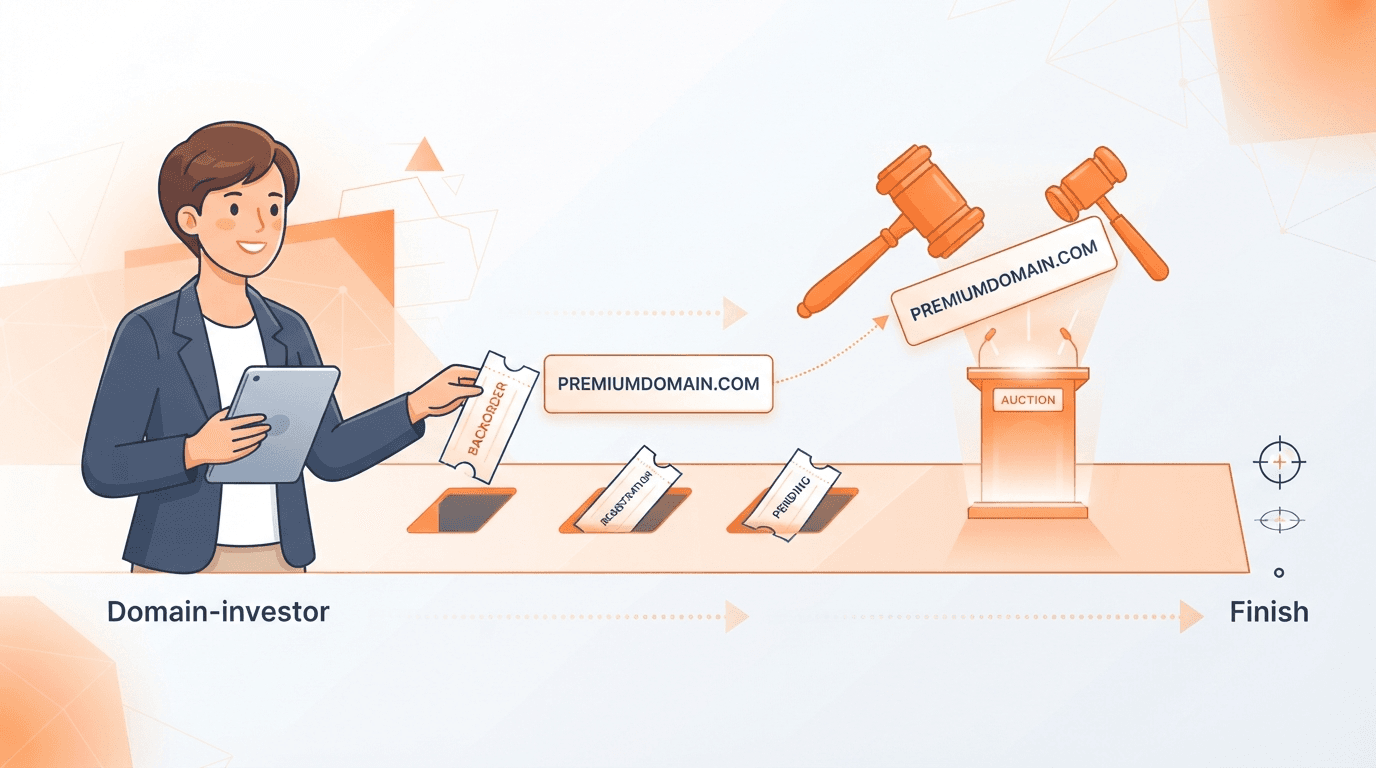
A domain backorder is a standing reservation on a name someone else currently owns: you pay a service to try to register it for you the instant it’s released back to the public pool. It is not a purchase, it doesn’t put the name on hold, and it doesn’t stop the current owner from simply renewing — which is what happens to most expiring domains. A backorder is worth placing when you want one specific name that’s genuinely heading for full deletion. It’s the wrong tool when the name will be pulled into its registrar’s own expiry auction first, which is where most of the good inventory actually goes.
I’ve been buying and flipping domains for more than twenty years, and backorders are the part of this business where I see beginners lose the most money for the least reason. Not because the service is a scam — the mechanics are honest enough — but because almost everything written about backorders explains how to place one and almost nothing explains whether yours will ever fire. Those are very different questions, and the second one is the one that decides whether you got a domain or a receipt.
So let’s do this properly: what a backorder actually is, the three ordinary ways it fails, what it really costs once you account for the part nobody advertises, and the pre-flight check I run before I reserve anything.
What is a domain backorder?
A backorder is a request you file with a service — a registrar or a dedicated drop-catcher — to monitor a registered domain and attempt to register it the moment it becomes available again. You give them the name in advance. They watch it. If it ever completes its expiry lifecycle and gets deleted, they race to grab it.
The word “backorder” is doing a lot of unhelpful work here. In every other context, a backorder means the item is coming and you’re in line for it. In domains it means nothing of the kind. There is no line, no reservation, and no obligation on anyone’s part to deliver you a name. You’ve hired a sprinter for a race that may never be run.
The race only happens at the very end of a fixed lifecycle. When a registrant stops paying, a gTLD domain walks through these stages:
- Grace period. The name expires, the website and email stop working, but the owner can still renew at the ordinary price. Length varies by registrar — Namecheap, for example, keeps most expired names in the owner’s account for 30 days before they move on.
- Redemption period. The name leaves the owner’s account and enters
redemptionPeriodat the registry. Recovery is still possible but now carries a hefty redemption fee. Per ICANN’s EPP status code documentation, this runs 30 days. - Pending delete. The name flips to
pendingDeleteand nobody — not even the former owner — can recover it. ICANN’s documentation is precise about this window: five calendar days after redemption ends, the domain is purged from the registry database and becomes available for registration. - The drop. The purge happens. For a fraction of a second the name is unowned, and every catch service that took a backorder on it fires registration attempts at the registry simultaneously. One wins.
That’s roughly two to two-and-a-half months from expiry to drop, and the entire value of your backorder rests on the name reaching step four. Most don’t.
Does a backorder actually get you the domain?
No, and it’s worth being blunt about the odds. A backorder fails in three completely ordinary ways, only one of which is bad luck.
Failure one: the owner renews. This is by far the most common outcome and the most boring. Expiry is usually an accident — a lapsed card, an old email address, a forgotten auto-renew — and the owner sorts it out during grace or redemption. Your backorder does nothing, correctly, and you got exactly what you paid for: a watch on a name that never became available. Nothing was wrong with the service.
Failure two: the name never drops, because a registrar sells it first. This is the one that costs people real money, and it’s the gap in every “how to backorder a domain” article I read while writing this. Registrars know that expiring inventory has resale value, so they don’t hand it back to the registry for free. They pull non-renewed names into their own aftermarket and auction them off during the expiry pipeline — before pending delete, before the drop, before your backorder’s finish line exists. Your reservation was aimed at a race that never happened, and the name sold in an open auction you weren’t watching. I cover the mechanics of that interception in drop catching vs. aftermarket auctions.
Failure three: you lose the race. The name genuinely drops and a bigger catch network gets there first. Catch services compete by holding registry connections across many accredited registrars — more connections means more simultaneous attempts means better odds — so a desirable .com is usually won by whichever service brought the most firepower. You pay nothing and get nothing.
And then there’s the outcome people mistake for a win. Your service catches the name — and hands you a bill. If two or more of that service’s own customers backordered the same domain, the catch triggers a private auction limited to those customers. You caught nothing; you qualified for an auction. That auction is where the real price gets set, and it has no relationship to the fee you paid.
The pre-flight check: will your backorder even fire?
Failure two is fixable, and this is the two-minute check that fixes it. Before I reserve any name, I answer four questions in order. Stop at the first “no” — that’s your answer.
- Where is this name registered right now? Look up the sponsoring registrar. If it’s a registrar that runs its own expiry aftermarket — and the large ones all do — assume by default that the name will be auctioned rather than dropped. Go watch that marketplace instead of paying for a backorder.
- Is it already listed somewhere? Search the name on the major aftermarkets before you reserve it. A name that’s already live as an auction listing is not going to drop, full stop. This single search kills more of my backorder candidates than anything else.
- What’s its actual EPP status? Run a WHOIS or RDAP lookup and read the status codes. A name sitting in
redemptionPeriodorpendingDeletewith no marketplace listing is genuinely headed for the drop — that is the profile a backorder is built for. A name that’s merely approaching its expiry date tells you almost nothing yet. - Is it worth a contested price, not just the fee? Price the name honestly before you reserve it, because if the catch succeeds you may be bidding against strangers within days. Pull three to five comparable sales on NameBio and set a walk-away number now, while you’re calm. My full method is in pricing a domain with real comps.
Four questions. Most candidates die on question two, and every one that dies there saved you a fee for a race that was never going to be run.
Backorder vs. auction sniping, side by side
These are not competing products for the same job — they intercept a name at opposite ends of its life. Read the Certainty and What you actually buy rows first; that’s where the difference lives.
| Factor | Backorder | Auction sniping |
|---|---|---|
| What you actually buy | An attempt — a queue position in a race | The domain itself, if you’re the high bidder |
| When it acts | At full deletion, ~60–75 days after expiry | During the expiry pipeline, before the drop |
| Inventory it reaches | Only names that survive to pending delete | Everything a registrar routes to its aftermarket |
| Certainty | None — owner may renew, name may be auctioned elsewhere, you may lose the race | Known close, visible price to beat, you see the field |
| Price discovery | Hidden until a private auction fires, if it fires | Open bid history from the moment you look |
| Cost model | Catch fee, plus a private auction if contested, plus registration | Winning bid + 10% buyer’s premium + registration (per Namecheap) |
| Best for | One specific name you already want, headed for the drop | Finding undervalued names at volume |
| Main failure mode | Nothing happens — quietly, weeks later | You get emotional and overpay |
Note the last row, because it’s the honest tradeoff. A backorder fails passively: you find out in two months that nothing happened. An auction fails actively: you chase a name past its real value and win something you shouldn’t have bought. The first wastes time, the second wastes capital — and only the second is under your control, which is why I’d rather fight my own discipline than a millisecond race. The fix for the second is a pre-committed maximum, which I walk through in how to snipe Namecheap domain auctions.
What a backorder really costs
The advertised fee is the smallest part of the number. As of mid-2026, per-name catch fees across the major services generally land somewhere between the low tens and under a hundred dollars — confirm the current rate on your provider’s own page, because these change and the terms differ (some bill upfront, some only on a successful catch). The comparison I ran across the major catch networks is in the drop-catching service roundup.
Now the part the pricing pages bury. Work through a contested catch with a labeled assumption — call the catch fee $59, and substitute your provider’s real number:
- Catch fee: $59 (assumed). This buys the attempt.
- Private auction: three other customers of the same service backordered the same name. The catch succeeds, and the four of you bid against each other. Nothing caps this. A name you valued at $400 can settle at $900 against one determined stranger, because you’re bidding blind against people who by definition wanted the same name enough to pay for a reservation.
- Registration: the first year, on top.
- Renewals: every year you hold it, forever, whether it sells or not.
Compare that to the same name won on an open aftermarket. On the Namecheap Market, you pay the winning bid plus a 10% buyer’s premium plus the first year’s registration, on a roughly seven-day auction with a visible bid history and a known close — the day’s auctions are scheduled together in the 11:00 AM ET batch, and payment is due within 72 hours of the close or the name re-lists (all per Namecheap). Bidding requires a Market subscription of about $5 a year. A $400 win costs you $440 plus registration, and you knew the price before you committed. The full arithmetic is in Namecheap Market fees explained.
That’s the real comparison: a known, capped, visible cost against an unknown one that only reveals itself after you’ve already paid to enter. Neither is wrong. But if you’re building a portfolio rather than chasing one trophy, you want the venue where you can see the price before you’re committed to it.
Can you backorder a domain on Namecheap?
No — Namecheap doesn’t offer a backorder service, and for names expiring at Namecheap you don’t want one. Those names are routed into the Namecheap Market aftermarket and sold by auction rather than released to the drop, which means the backorder mechanism has nothing to act on. Instead of buying a lottery ticket, you get an open auction with a visible price to beat, proxy bidding from your own account, and names that attract no bids rolling into a reduced $5 closeout (per Namecheap). The mechanics are broken down in Namecheap Market auctions explained.
For a name expiring at a different registrar, you still need an outside backorder or drop-catch service — and you still need the pre-flight check above, because that registrar probably runs its own aftermarket too. It’s worth knowing that this category has been consolidating: GoDaddy retired its standalone backorder and monitoring products in October 2025 and now routes buyers to GoDaddy Auctions instead, which tells you which way the industry read the economics. I compare the two venues in Namecheap vs. GoDaddy Auctions.
When a backorder is the right tool
I’m not anti-backorder. I’m anti-reflexive backorder. Reserve a name when all of these are true:
- You want that exact name. Not “a name like this” — that one. A competitor’s lapsed domain, the matching
.comfor a brand you already run, an exact-match keyword you’ve tracked for a year. Backorders are terrible discovery tools and excellent targeting tools. - It cleared the pre-flight check. Sitting in redemption or pending delete, with no aftermarket listing anywhere.
- You’ve set a walk-away price. Written down, before the private auction, based on comps rather than the sunk fee.
- You can accept getting nothing. Because that’s the most likely outcome, and it has to be survivable rather than infuriating.
Skip the backorder when you’re building a portfolio, when you care about a type of name rather than a specific one, or when the name is heading for an aftermarket you could just go bid in. Which — if you’re honest about your own buying — covers most of what most investors actually do.
The thing a backorder can’t do
Here’s the structural limitation. A backorder only works on names you already thought of. You have to know the domain, type it in, and pay to watch it — which means your entire pipeline is capped by your own imagination. The names that actually make money in this business are overwhelmingly the ones you’d never have searched for: a clean two-word pairing, a pronounceable five-letter brandable, a real dictionary word in a niche you don’t follow. You can’t backorder a name you’ve never heard of.
That’s the problem I built PounceDomains to solve, from the opposite direction. Rather than watching names you nominate, it watches the whole Namecheap aftermarket around the clock through the official Auctions API, applies your structural filters to every ending-soon auction, and AI-scores the survivors against the strategies you care about — then enriches the keepers with comps, backlink and age signals, and a suggested max bid, and alerts you while the name is still biddable. It also watches drops and manages the portfolio you’ve already built. The point isn’t automation for its own sake; it’s that discovery scales and your attention doesn’t. Screening every candidate against a real expired-domain filter is the work, and it’s the work nobody has time to do by hand.
The bottom line
A domain backorder is a bet that one specific name will survive its entire expiry lifecycle without being renewed and without being auctioned — and then that your service wins a race measured in milliseconds. That bet is occasionally worth making, for a name you genuinely need, after you’ve confirmed it’s actually headed for the drop and priced what you’d pay in a contested auction. It’s a scalpel.
For everything else — for building a portfolio out of undervalued names you haven’t thought of yet — the aftermarket auction is the deeper, more transparent, more forgiving venue, and the leverage isn’t in bidding faster. It’s in seeing the right names before anyone else bothers to look. Start a free trial and let the discovery run while you sleep.
Frequently asked questions
What is a domain backorder?
A domain backorder is a standing reservation you place on a name that someone else currently owns, instructing a service to try to register it for you the instant it is released back to the public pool. You are not buying anything from the current owner and you are not putting the name on hold — nothing about your backorder stops that owner from simply renewing, which is what happens to the large majority of expiring domains. What you are actually buying is a queue position in a race: the service watches the name through its expiry lifecycle and, if it ever reaches full deletion, fires registration attempts at the registry in the milliseconds after release. Think of it as hiring a sprinter rather than making a purchase.
Does a domain backorder guarantee you get the domain?
No, and any service implying otherwise is overselling. A backorder fails in three completely ordinary ways. The owner renews during the grace or redemption period, which is the single most common outcome and ends the matter entirely. The name gets pulled into the losing registrar's own expiry auction and is sold there instead of ever dropping, so your reservation never fires at all. Or the name does drop, and a competing catch service with more registry connections wins the race by milliseconds. There is also a fourth outcome people mistake for success: your service catches the name, but two or more of its customers backordered it, so it goes to a private auction between you and pay whatever it takes to win.
How much does a domain backorder cost?
Most services charge a per-name catch fee that, as of mid-2026, generally lands somewhere in the low tens to under a hundred dollars depending on the provider — always confirm the current rate on the provider's own page, because these move. Some charge upfront, some only on a successful catch. The headline fee is rarely the real cost, though. If more than one customer backordered the same name, the service catches it and then resells it in a private auction limited to those customers, so a modest catch fee can settle for several hundred or several thousand dollars. Budget for the auction outcome, not the sticker price, and remember you still pay the ordinary registration and every annual renewal after that.
Why did my domain backorder fail?
Usually because the name never dropped. Check the domain's status first: if it is registered again under a new owner with no gap, the original registrant renewed and your backorder correctly did nothing. If the name shows up listed on a registrar's aftermarket, it was pulled into that registrar's expiry auction, which happens before deletion — your backorder was aimed at a finish line the name never reached, and the auction was where you needed to be. If it dropped and someone else holds it, you lost the millisecond race to a larger catch network. Only the third case is bad luck; the first two are a targeting problem you can fix by checking where a name is actually headed before you reserve it.
Can you backorder a domain on Namecheap?
Namecheap does not run a backorder service, and for names that expire at Namecheap you do not need one — they are routed into the Namecheap Market aftermarket and sold by auction rather than released to the drop. That is a better deal for a buyer than it sounds: instead of paying a catch fee for a lottery ticket, you get an open auction with a visible price to beat, roughly seven-day runs closing together in the daily 11:00 AM ET batch, proxy bidding from your own account, and a 10% buyer's premium on the win (per Namecheap). Names with no bids can even roll into a reduced $5 closeout. For a name expiring at a different registrar, you still need an outside backorder or drop-catch service.
Mark Fulton
Developer & Founder of PounceDomains · 20+ year domain investor
Mark Fulton is a 20+ year domain investor and the developer and founder of PounceDomains. He has spent two decades buying, building, and flipping domain names, and built PounceDomains himself to automate the hunt for undervalued domains on the Namecheap aftermarket.
Keep reading
Check if a Domain Is Banned by Google Before You Bid
You cannot open Search Console on a domain you do not own yet. Here are the four checks a 20-year investor runs instead, and the pass/fail call at the end.
Domain Trademark Check: Screen Before You Buy (2026)
How to run a domain trademark check before you buy a name — a 20-year investor's fast USPTO and WIPO workflow, the risky-name red flags, and a buy-or-walk decision tree.
Snipe these domains automatically
PounceDomains watches Namecheap Market 24/7, scores every ending-soon domain with AI, and bids on the winners. Free to start.
Start sniping free