
Domain Hunter Gatherer Review: Worth It, or an Alternative?
Is Domain Hunter Gatherer worth it in 2026? What it actually does, what it costs, why it will not run on a Mac, and which alternative fits the job you need done.
 Mark FultonAug 13, 12:00 AM UTC10 min read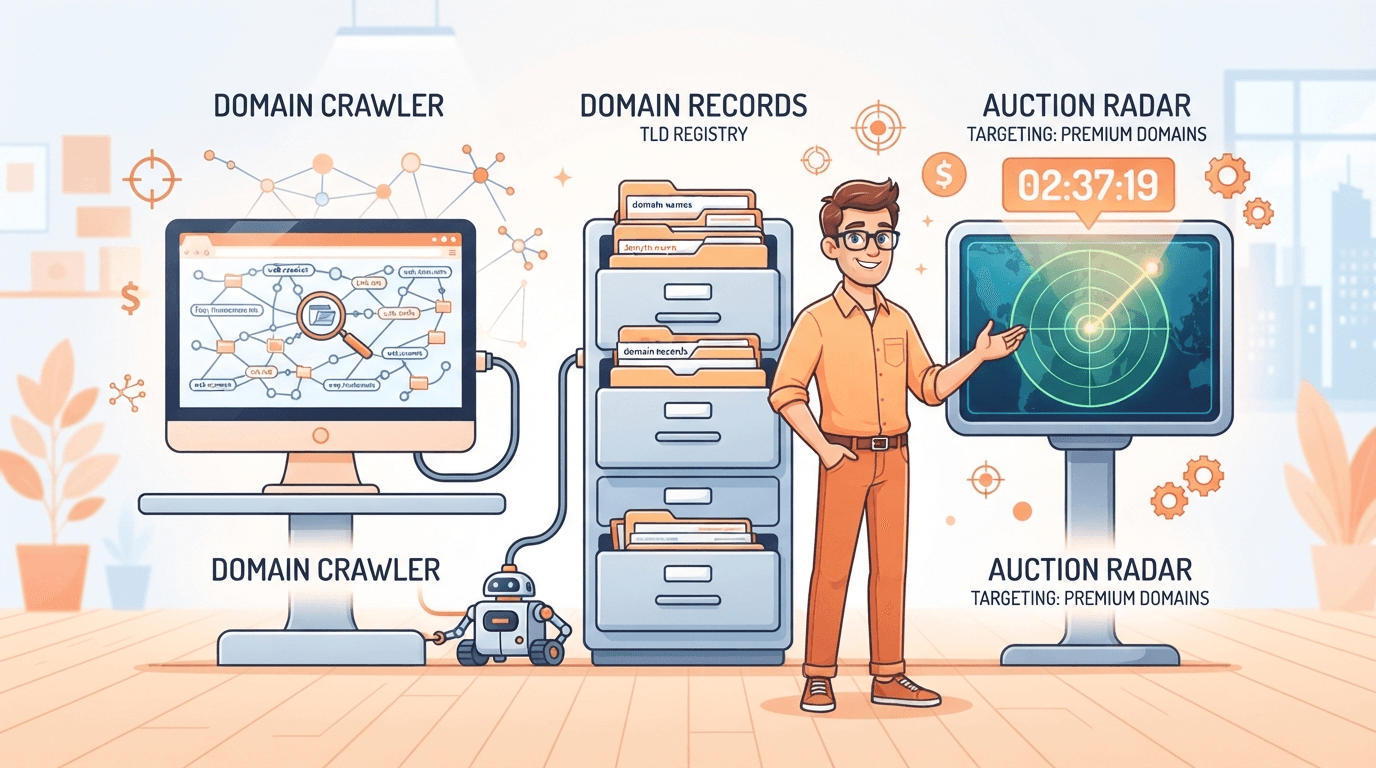
Domain Hunter Gatherer is not one product, it is three machines in one box — a crawler that goes out and finds expired domains from a seed you choose, a metrics layer that grades what it dragged back, and an auction search that sweeps marketplace inventory on demand. Almost nobody uses all three. So before you pick an alternative, work out which machine actually failed you, because the replacements are completely different products and swapping in the wrong one leaves you with the same complaint and a new invoice. After 20+ years of buying names, this is the switch I see people make blind more than any other.
Look at what this search returns today. A software directory whose automated “top alternatives” list is headed by a static-site host, a DNS monitoring service, and a server management panel — three products that have nothing whatsoever to do with finding domains, surfaced because the algorithm matched on traffic overlap rather than on job. A crowdsourced alternatives page listing twelve tools in a column, several of which are WHOIS data APIs rather than hunting tools, with a one-line blurb and a like count each. A “19 alternatives for Windows” page assembled from the same feed. Two genuinely detailed reviews — one around 2,500 words, one over 5,000 — both of which are reviews of Domain Hunter Gatherer and end up recommending it, which is a strange answer to the question “what should I use instead.” And a forum thread that is half product launch.
Not one of them asks the only question that matters here: which part of the tool are you replacing?
What does Domain Hunter Gatherer actually do?
It crawls, and that verb is doing more work than the marketing suggests. Most tools in this space are databases: somebody else has already assembled a list of expiring and dropped names, and you filter it. Domain Hunter Gatherer is a crawler that runs on your own machine and goes outward from a seed you give it — a competitor’s site, a Wikipedia article, a keyword search — following links and checking which of the domains on the other end are expired or available. That means it can find names that never appear on anybody’s list, because the discovery path is yours rather than shared.
Bolted onto that are the other two machines. A metrics layer pulls third-party authority and backlink data and lets you filter on it, with the vendor advertising filtering across 40-plus factors. An auction module sweeps marketplace inventory, and a Web 2.0 module hunts expired accounts on hosted blog platforms. A recovery feature rebuilds a dead site’s content from archived snapshots held by the Internet Archive, which has been keeping a public record of the web since the 1990s.
Add those up and the audience is unambiguous. This is a tool for people buying expired domains for their link equity — private blog networks, 301 redirects, seed sites for affiliate builds. Google’s own search spam policies name expired domain abuse as a distinct violation — buying an expired name and repurposing it primarily to manipulate rankings with content of little or no value — so that lane carries real risk, and the people working it need exactly this kind of history-first tooling to stay on the right side of it. Judged as a tool for that buyer, it is good. As of August 2026 the vendor’s own site lists a free forever tier, Premium at $27 a month, and Pro at $97 a month, with annual billing working out to roughly $21 and $57 a month. Verify those on the vendor’s pricing page before you subscribe — the coupon and group-buy sites that crowd this search quote figures that are not official.
Why do people look for an alternative?
Five reasons, and they lead to five different products. I have heard all of them; only two are actually about the software.
It does not run on a Mac. There is no supported Mac build, so you are in a virtual machine or a Windows partition. That is the single most common trigger, and it is also the most misdiagnosed — people go looking for the same thing on a different operating system when the real fix is a tool where the work does not happen on your computer at all.
It is heavy. Crawling at volume eats CPU and bandwidth, and the reviews that like the product most are the ones that mention needing proxies for bulk searches so search engines do not throttle your IP. That is a second subscription and a second thing to maintain.
It only works while you are at the keyboard. A desktop crawler discovers nothing overnight, and this is the complaint people articulate last and feel first.
The metrics describe the wrong thing. Every number it surfaces is about a link profile. If you buy names to resell to a business rather than to rank, none of them predicts your outcome.
Names keep closing without them. Not a software complaint at all. This is a timing problem wearing a tooling costume, and no crawler on any platform fixes it.
Which machine are you actually replacing?
Here is the frame that makes the whole shopping trip simple. There are three mechanisms in domain hunting, they are not interchangeable, and every product in this category is really one of them with the other two sketched in. Find your row before you look at a single price.
| 1. The crawler | 2. The database | 3. The venue monitor | |
|---|---|---|---|
| What it is | Software that follows links outward from a seed you choose and checks what is expired on the other end | A pre-assembled index of expiring, dropped, and listed names that you filter | A service that watches one marketplace continuously and reacts to what changes there |
| Where it runs | Your machine, while you watch it | Someone else’s servers, queried on demand | Someone else’s servers, on a schedule you never touch |
| What it is uniquely good at | Finding names nobody else is looking at, because the discovery path is private to you | Breadth and speed — hundreds of millions of names cut down in seconds | Knowing what is about to happen, not what happened this morning |
| Its structural blind spot | Discovers nothing while the machine is off; capped by your hardware and your hours | Stale between refreshes, and every subscriber is filtering the identical corpus | Sees one venue deeply and the rest of the internet not at all |
| What it costs you beyond the fee | Proxies, CPU, and your presence at the keyboard | Nothing but the time you spend filtering | Nothing, which is exactly why it is the easiest gap to leave unfilled |
| Who genuinely needs it | PBN and 301 builders hunting a specific competitor’s links | Anyone doing a first mechanical cut on volume | Anyone who buys at auction rather than at a fixed price |
| Named examples | Domain Hunter Gatherer | ExpiredDomains.net, DomCop, Spamzilla | PounceDomains |
Read the bottom row again, because it is the reason the alternatives pages are useless. Nearly every tool named as a Domain Hunter Gatherer alternative sits in column two. If column one is what you valued, those swaps are a downgrade dressed as a lateral move — you lose the seeded crawl and gain a corpus that every other subscriber is already filtering. And if your actual problem is column three, no amount of shopping in either of the first two columns will touch it.
What replaces the crawler?
Very little, and I would rather say that plainly than pad a list. Seeded outward crawling from your own machine is a genuinely uncommon mechanism because it is expensive to run and awkward to host — the whole reason it lives on your desktop is that the vendor is spending your CPU and your IP address instead of theirs. If that capability is why you bought the tool and you use it weekly, the honest advice is to keep it and solve the Mac problem with a virtual machine.
If you use it occasionally, you can rebuild the important slice by hand. Pull the backlink profile of the competitor you were going to seed, export the referring domains, and bulk-check which are expired or expiring. That is the same idea at a smaller scale, it costs nothing beyond a link tool you probably already have, and it collapses the moment you want to do it across fifty targets. The discipline for reading what comes back is the same either way, and I worked it through in checking domain backlinks before buying — read the metric pair, never one number, because high link volume with near-zero trust is a spam signature rather than a bargain.
Be honest about the usage question first, though. In my experience most people who buy a crawler end up living in its auction and database screens and touch the seeded crawl twice a year. If that is you, you are paying for column one and using column two, and the alternative you want is a database.
What replaces the database and metrics?
This half has real competition and the choice comes down to money and depth. The free option is genuinely good: ExpiredDomains.net indexes hundreds of millions of expired, deleted, and marketplace names with a deep filter set and no paywall on the core search, and it covers venues the paid tools skip — I mapped where it stops helping in the ExpiredDomains.net alternative question. The deep paid option layers licensed authority and traffic metrics on a similar corpus for four figures a year, which is worth it at volume and absurd otherwise; that arithmetic is in the DomCop alternative routing exercise. And if what you specifically want is history screening rather than discovery, the spam-scoring specialists do it better than a general crawler does, which I compared in the Spamzilla alternative question.
One caution that applies to all three. A hosted database is a shared corpus, so every subscriber sees the same names with the same scores at the same moment. That is fine for the mechanical cut and useless as an edge. Whatever you save by moving from a crawler to a database, you give back in differentiation, and the way you get it back is judgment applied after the filter rather than a better filter.
Why do good names keep closing without you?
Because none of these tools has a relationship with a clock, and this is the gap I would fix first if I were rebuilding somebody’s stack from scratch.
An auction search — whether it runs on your desktop or on a vendor’s servers — is a query. It reports what is listed at the instant you press the button. It does not know that the name you liked on Tuesday is closing at 11 in the morning on Thursday, it does not notice when a listing you flagged drops to a no-bid closeout, and it cannot tell you that a competitor just moved past your ceiling. All of that happens in the space between two searches, and the space between two searches is where names are won and lost.
On the Namecheap Market specifically, the mechanics that live in that gap are documented rather than mysterious. Namecheap’s Auctions Bidding Guide sets out a $5-per-year Market subscription, a $100 minimum account balance before you can bid at all (rising to $1,000 for bids of $10,000 or more), a five-minute extension whenever a bid lands in an auction’s final five minutes, payment due within 72 hours of the close, and the rule that ends most arguments — a maximum bid can never be decreased once it is placed. Layer the 10% buyer’s premium Namecheap adds to a winning bid on top and the all-in number is meaningfully above what you typed. A crawler knows none of this. Neither does a database. The full mechanics are in Namecheap Market auctions explained, and the arithmetic for turning comparable sales into a defensible ceiling is in the maximum bid worksheet.
Which alternative fits which complaint?
Five symptoms, five honest routes.
“It will not run on my Mac.” If you use the seeded crawl, run it in a virtual machine and stop shopping. If you do not, move to a hosted database and you have solved the operating system question permanently, because there is nothing to install.
“It slows my computer down.” Same answer, for the same reason. The fix is moving the work off your hardware, not finding a lighter crawler.
“It costs too much.” The free aggregator covers the database half at zero cost. What you give up is polish and pre-processing, which is the right trade while your bottleneck is budget and the wrong one once your bottleneck is attention.
“The metrics do not tell me if a name will sell.” They never will, because they were built to describe link profiles. You need brandability judgment and evidence-based pricing from real comparable sales, and the mechanical version of what a keeper looks like is in how to find valuable expired domains.
“I keep missing auctions.” Column three. Nothing in the first two columns will help, at any price, and the wider category map is in the domain sniping tools roundup.
Where does PounceDomains fit, honestly?
Not as a Domain Hunter Gatherer replacement, and the comparison is unflattering in the places that tool is built to win. We do not crawl outward from a seed, so we will never find the expired domain linking to a specific competitor’s resource page. We do not carry a forty-factor SEO filter set, we do not hunt expired Web 2.0 accounts, and we do not rebuild dead sites from archived snapshots. If you buy names for link equity, that tool is built for you and I am not going to pretend otherwise. Our other real limitation is narrowness: we watch the Namecheap Market, not eight venues.
What PounceDomains is, is column three. It watches that one venue around the clock, applies AI scoring for brandability and resale appeal against configs you write yourself, enriches every ending-soon match with comparable sales, authority signals, and a conservative resale range, flags the drops closing with no bids, manages the portfolio you build from it, and puts a suggested maximum in front of you while the name is still biddable. It runs when your laptop is shut, which is the entire point. Plenty of people run a crawler and a monitor together, and that is the sane arrangement rather than a compromise: private discovery from a desktop tool, presence at the close from something that never sleeps. You can start a free account and have a config running in a couple of minutes.
Whatever you choose, write down which machine you are buying before you enter a card number. Column one is a discovery edge you have to work for. Column two is a commodity you should not overpay for. Column three is the one almost nobody buys deliberately, and it is the one that decides whether the names you already found end up in your account.
Frequently asked questions
What is the best Domain Hunter Gatherer alternative?
There isn't a single one, because Domain Hunter Gatherer is three products in one box and almost nobody wants all three. It is a crawler that goes out and finds expired domains linked from pages you point it at, a metrics layer that grades what it found, and an auction search that sweeps marketplace inventory. If what you want is the crawling — seeded from a competitor's backlinks, a Wikipedia article, or a keyword search — you want another crawler, and the honest shortlist is short because that mechanism is genuinely rare. If what you want is the metrics and the inventory without running software on your own machine, you want a hosted database, and ExpiredDomains.net is free, DomCop is the deep paid option, and Spamzilla is the spam-screening cut. If what you want is to stop missing auctions that close while you are asleep, you want neither of those — you want something watching a venue on a clock, which is a third mechanism that no crawler and no database performs. Name the machine before you shop and the list stops being a popularity contest.
Is Domain Hunter Gatherer worth it?
For a private-blog-network or 301-redirect builder, yes, and I would not argue anyone out of it. As of August 2026 the vendor's own site lists a free forever tier, Premium at $27 a month, and Pro at $97 a month, with the annual plans working out to roughly $21 and $57 a month respectively. Against that, the tool does something most of the category does not: it crawls outward from a seed you choose, so you can hunt the expired domains that link to a specific competitor rather than filtering a list everybody else is filtering. That is a real edge if link equity is what you buy. For a brandable reseller it is a poor fit at any price, because every metric it surfaces describes a link profile and none of them predicts whether a business would pay for the name. Confirm the current tiers on the vendor's pricing page before you subscribe — the coupon and group-buy sites that dominate this search quote numbers that are not official.
Does Domain Hunter Gatherer work on Mac?
No. It is Windows desktop software, and that single fact drives a large share of the alternative searches for it. There is no supported Mac build, so Mac users are left running it inside a virtual machine or a Windows partition, which works but adds a layer of setup and a performance penalty to a tool that is already resource-hungry when it crawls. The deeper issue is not the operating system, though — it is that the work happens on your computer. A desktop crawler only finds things while it is open and running, which means your discovery is capped by how many hours a day your machine is on and how much of its CPU you are willing to give up. If you are shopping because of the Mac problem, do not just look for the same product on a different OS. Look for one where the finding happens on somebody else's hardware, because that removes the operating system question and the availability question at the same time.
Is there a free alternative to Domain Hunter Gatherer?
For the database half, yes and it is genuinely good — ExpiredDomains.net has run a free search over hundreds of millions of expired, deleted, and marketplace domains for years, with deep filters and no paywall on the core search. For the crawling half, no free tool reproduces seeded outward crawling, and that is the part worth paying for if you actually use it. You can approximate a slice of it manually: pull a competitor's backlink profile in any free-tier link tool, export the referring domains, and bulk-check which of them are expired or expiring. That is the same idea done by hand, and it works fine for one target and falls apart across fifty. Be honest about which half you use. Most people who buy a crawler end up living in its auction and database screens, and they are paying a subscription for a feature they touch twice a year.
Does Domain Hunter Gatherer cover Namecheap auctions?
Its own homepage lists NameCheap among the auction sites its Domain Auctions module searches, alongside GoDaddy, Flippa, Above, Dynadot, and HugeDomains, so coverage is not the gap here and I will not pretend otherwise. The gap is time. An auction search is a query you run: it tells you what is listed at the moment you press the button, and it knows nothing five minutes later. The rules that decide whether you actually get the name all live in that gap, and Namecheap's Auctions Bidding Guide documents them plainly — a $5-a-year Market subscription, a $100 minimum account balance before you can bid at all, a five-minute extension whenever a bid lands in an auction's final five minutes, payment due within 72 hours of the close, and no decreasing a maximum bid once it is placed. A search screen has no relationship to any of that. It shows you the name; it does not tell you the name is closing while you are at lunch.
Mark Fulton
Developer & Founder of PounceDomains · 20+ year domain investor
Mark Fulton is a 20+ year domain investor and the developer and founder of PounceDomains. He has spent two decades buying, building, and flipping domain names, and built PounceDomains himself to automate the hunt for undervalued domains on the Namecheap aftermarket.
Keep reading
GoDaddy Auctions Alternative: Where Else to Buy Drops
GoDaddy has the most inventory, and that is not the only thing that matters. A venue-by-venue guide to buying expiring domains elsewhere, keyed to what you hunt.
Karma.Domains Alternative: What the Score Can't See
Looking for a Karma.Domains alternative? A 20-year investor on what the Karma Score really measures, what it can't, and the auction clock no history tool watches.
Snipe these domains automatically
PounceDomains watches Namecheap Market 24/7, scores every ending-soon domain with AI, and bids on the winners. Free to start.
Start sniping free