
Domain Investing for Beginners: A 30-Day Roadmap
A 20-year investor's beginner guide to domain investing: your first budget, where to actually buy, the four checks before you bid, and a day-by-day 30-day roadmap.
 Mark FultonAug 6, 12:00 AM UTC11 min read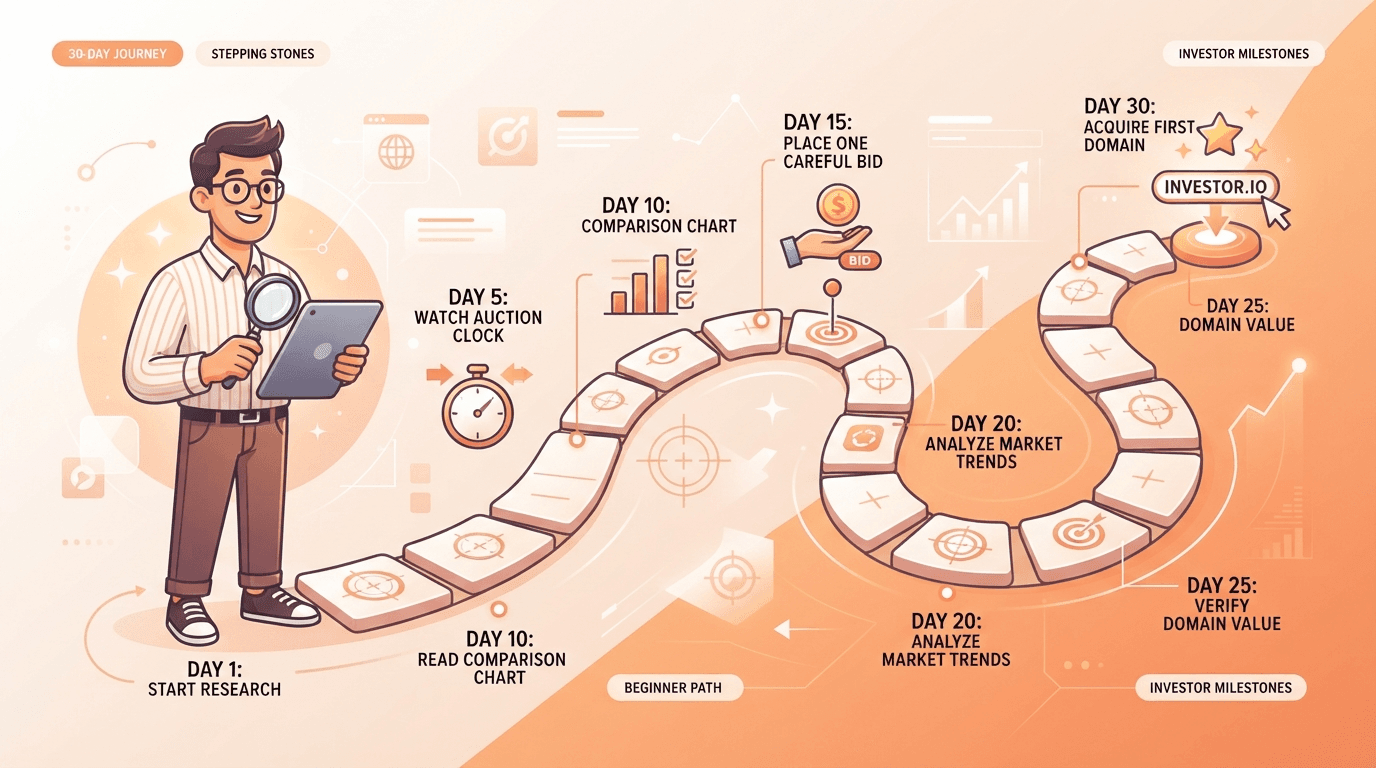
Domain investing for beginners comes down to one loop repeated patiently: buy a name on the aftermarket for less than it would resell for, carry it while you wait for the one buyer who needs it, and sell for more than your all-in cost. You do not need a big budget, a registrar connection, or a clever idea. You need a way to see what is for sale, a method for pricing it, and the discipline to stop bidding at a number you decided before the auction started. After 20+ years doing this, I can tell you the failure mode is almost never a bad name. It is buying too many names, too fast, at prices nobody would pay you back.
Most beginner guides on this topic are published by registrars, which is why they open with a $872 million sale and close with an invitation to hand-register something. That framing is backwards. Hand-registering an idea you thought of yesterday is the least likely path to a sale, because the good version of your idea was registered decades ago. This guide takes the opposite approach: a realistic first budget, the aftermarket where names actually become available, the four checks that take five minutes each, and a day-by-day 30-day roadmap that ends with you having bought two or three names on purpose rather than twenty on impulse.
How does domain investing actually work?
Strip away the vocabulary and it is a resale business with an unusual inventory. You acquire an asset that costs a small amount to hold, you hold it until someone with a specific need arrives, and you sell it to them. Three details make domains different from most resale businesses, and all three should shape how a beginner behaves.
- The inventory renews itself annually. Every name you own bills you every year whether or not it sells. That turns a portfolio into a subscription you pay, so carrying cost — not purchase price alone — decides whether you profit.
- Liquidity is terrible. There is no market price and no bid you can hit on a Tuesday. You are waiting for the single buyer who wants that exact string, which can take months or years. Only a small single-digit share of an ordinary portfolio sells in any given year.
- Supply arrives on a schedule. Names do not sit waiting to be discovered; they come back into circulation when owners stop renewing, cycle through an expiry lifecycle, and get auctioned. That flow is your sourcing pipeline, and it runs every single day.
Put those together and the strategy writes itself: buy few names, buy them below resale value on the aftermarket, keep carrying costs low, and be genuinely patient. The full economics of the resale side live in How to Make Money Flipping Domains, which is the pillar this guide sits under.
How much money do you need to start?
Less than you think, and the number matters less than how you split it. A few hundred dollars is enough to run one complete cycle — watch, research, bid, win, hold — and running that cycle once teaches you more than reading twenty guides. Treat your first allocation as tuition, not capital.
On the Namecheap Market the fixed costs of participating are small and published. Namecheap lists a Market subscription at $5 per year, and its Auctions Bidding Guide states that a $100 account balance minimum is required so that only verified bidders participate (with a higher threshold for bids of $10,000 or more). Winners pay a 10% buyer’s premium on the winning bid plus the standard registration, and payment is due within 72 hours of the auction’s close or the name re-lists. Those are the real numbers to plan around; the full breakdown is in Namecheap Market Fees Explained.
Here is how I would divide a $500 first budget, and the logic transfers to any number you pick:
| Allocation | Amount | Why it’s there |
|---|---|---|
| Market subscription | $5 / year | The published cost of being allowed to bid at all — a rounding error, but it has to exist before you can act. |
| First two or three names | ~$150 | Bought over several weeks, not one afternoon. This is the money you expect to learn from rather than profit from. |
| Reserve for a real opportunity | ~$250 | The good name shows up in week five, not week one. Spend everything early and you will watch it close without you. |
| Year-two renewals | ~$95 | Every name bills again in twelve months. Budget it now or your second year starts with a forced sale. |
Note what is not on that list: tools, courses, and a domain-flipping community subscription. None of those are the constraint in month one. Your judgment is.
Where do beginners actually buy domains?
Three doors exist, and beginners overwhelmingly walk through the wrong one first.
Hand-registration — thinking of a name and registering it fresh — is the cheapest and the least likely to work. Every common dictionary word, every clean two-word pairing you would think of in a brainstorm, and every short letter string on .com was claimed decades ago. What is left available is what nobody wanted. Beginners love this door because it costs $10; that $10 becomes $10 every year forever, which is exactly how people end up with forty names and no inquiries.
Buying from a current owner works but starts at retail. You are approaching someone who already decided their name has value, so you are negotiating against their number, not discovering an undervalued one.
The aftermarket is where the actual opportunity is. A domain that is not renewed does not vanish — Namecheap’s own support documentation on what happens after a domain expires describes a 30-day grace period followed by a redemption period before the name leaves the owner’s control for good. Names that complete that path get auctioned rather than quietly deleted, which means a continuous supply of already-established names with real age and real history, priced by whoever else happens to be paying attention that morning. That last clause is the entire edge: on any given day, most of the good names close with very few bidders, because almost nobody has the patience to read a daily flood of listings.
On the Namecheap Market, auctions typically run about seven days and the day’s batch is scheduled to close together at 11:00 AM ET, with proxy bidding handling the mechanics — a late bid in the final five minutes extends that auction by five minutes, per the Auctions Bidding Guide, which is why last-second sniping does not work there. The mechanics are covered fully in Namecheap Market Auctions Explained and Namecheap Proxy Bidding Explained.
What should a beginner buy?
Buy names a real business would want to be called. That sounds obvious and it eliminates roughly 95% of what you will see. Four categories carry enough liquidity to be worth a beginner’s money:
- Clean two-word
.coms that read as a single idea — the workhorse tier, and the most realistic place to find quality on a small budget. - Pronounceable five-letter brandables — if you can say it once and spell it back, it is sellable. See Pronounceable Brandable Domains.
- Short letter strings (LLL/LLLL) — scarcity puts a floor under the price whether or not the string means anything.
- Real dictionary words with commercial use, when the aftermarket misprices one.
Stay on .com while you are learning. It remains the most liquid resale extension by a wide margin, and liquidity is what forgives a beginner’s mistakes — a mediocre .com has a buyer pool, while a great name on an exotic extension often does not. The tradeoffs across extensions are laid out in Best TLDs for Domain Investing.
The four checks before you bid
Every name I buy passes four screens, and none of them takes more than five minutes. Skip them and you will eventually buy a name that cannot be resold for reasons that were visible before you bid.
- Price it with comps. Pull three to five real reported sales that match the name on length, extension, and style, and let that cluster set your range. One sale is an anecdote. The full method is in NameBio Domain Sales: Price With Real Comps.
- Read its history. A name that spent three years as a casino doorway page carries that past into your ownership. Two minutes in an archive tells you what actually sat on the domain — see Wayback Machine Domain Research.
- Check the trademark. Run the second-level string through the USPTO’s trademark search system as one word and as separate words. A mark holder can force a transfer regardless of what you paid, which makes this the cheapest insurance in the business. Details in Domain Trademark Check.
- Set the maximum bid before you bid. Work backward from resale value: subtract the selling commission, subtract the renewals you expect to pay while holding, subtract your profit margin, then strip out the 10% buyer’s premium and first-year registration. Whatever survives is your ceiling. Write it down. The worksheet is in Maximum Bid Strategy.
One more rule that sounds trivial and is not: make the maximum an odd number. Namecheap’s bid increments start at $1 for prices under $50, so a ceiling of $443 quietly beats the crowd of bidders who all rounded to $450 — and ties go to whoever got there first, not whoever wanted it more.
The 30-day beginner roadmap
This is the part no other beginner guide gives you, and it is the part that actually changes outcomes. Two full weeks of buying nothing feels like wasted time; it is the highest-return fortnight in your first year, because it converts guesses into calibrated estimates before any money moves.
| Days | What you do | What it buys you |
|---|---|---|
| 1–3 | Open the Namecheap Market, add the subscription and account balance, and read the Auctions Bidding Guide end to end. Buy nothing. | You know the real cost of a win before you ever want one. |
| 4–7 | Watch the daily 11:00 AM ET close. Each morning, write down five names you would bid on and the price you predict they close at. | A calibration log. Your predictions will be badly wrong in week one — that is the point. |
| 8–14 | Keep predicting, but now pull comps on every name before you guess. Compare your estimate to the actual close. Still buy nothing. | The gap between your estimates and reality closes fast once comps are in the loop. |
| 15–21 | Run the four checks on your best three candidates. Write a maximum bid for each. Place one bid, once, and do not raise it. | Your first acquisition — or your first disciplined loss, which is worth nearly as much. |
| 22–28 | Buy one or two more at most. Start a portfolio sheet: cost, renewal, expiry, comps-based estimate, date acquired. | A ledger from day one, so year two’s renew-or-drop calls are arithmetic instead of sentiment. |
| 29–30 | List what you bought, set asking prices from your comps, and write down why you bought each name. | A record you can audit in a year — the fastest way to find out which of your instincts are real. |
At the end of thirty days you own two or three names you can defend with evidence, and you have a calibration log that makes month two meaningfully better than month one. Compare that to the alternative beginner path — forty hand-registrations and a renewal bill.
How do you sell what you bought?
Two channels, and beginners should use both. Passive listing puts the name where buyers already search: a for-sale landing page on the domain itself plus a listing on the marketplaces buyers actually browse. Active outbound means identifying businesses that would genuinely benefit from the name and contacting them directly — it converts far better and takes real work. Price from your comps, not from what you paid, and expect a long wait either way. The venue comparison is in Where to Sell Domains.
The counterpart to selling is dropping. Treat every renewal as a fresh buy decision: if you would not pay today’s registration price to acquire that exact name right now, let it go. Names that have sat two or more years with zero genuine inquiries and no defensible comps are dead weight, and quietly auto-renewing them is the biggest silent drain on a new investor’s returns. The audit cadence is in Domain Portfolio Strategy.
The beginner mistakes that cost the most
- Buying volume instead of quality. Forty names you cannot price is forty renewals. Ten you can defend is a portfolio.
- Raising your maximum because you got outbid. Being outbid is not new information. It is the auction telling you the name is going to someone who values it more.
- Forgetting the fees. The buyer’s premium and first-year registration land on top of your bid, and every renewal lands on top of that. A margin that looked fine at the bid screen disappears by year three.
- Trusting an appraisal tool’s number. Automated appraisals are a starting point at best. Real reported sales are the only defensible input — see How to Value a Domain Name.
- Chasing the two names you had time to look at. With hundreds of auctions closing in the same batch, the names you happened to see are not the best names available. More on this in Domain Auction Mistakes.
What tools does a beginner actually need?
In month one: a comps source, an archive to read a name’s history, a trademark search, and a spreadsheet. That is genuinely the whole kit, and anyone selling you more than that in your first thirty days is selling you comfort.
The tooling question becomes real at exactly one point — when your bottleneck stops being budget and starts being attention. Thousands of names move through the aftermarket daily, they all close in the same batch, and the ones worth owning are buried in a flood no person reads end to end. That is the job PounceDomains does: it monitors the Namecheap Market around the clock through the official Auctions API, AI-scores and enriches every ending-soon name against configs you dial in, and emails you the matches with comps, appraisal context, and a suggested maximum while the auction is still live — so the names you would have bought anyway actually reach you in time. How that fits the wider tooling landscape is covered in Namecheap Marketplace Domain Sniper App, and the sourcing side in How to Find Valuable Expired Domains.
The bottom line
Domain investing rewards patience and punishes enthusiasm, which is an unusual combination for a business that markets itself on excitement. Your first thirty days should produce a calibration log, two or three defensible names, and a spreadsheet — not a portfolio. Buy on the aftermarket where names are actually mispriced, run the four checks every time, decide your maximum before the auction and never move it, and let the renewals of your worst names teach you something rather than bleed you quietly. Do that for a year and you will be ahead of most people who started when you did. When the flood of daily listings becomes the thing standing between you and the good names, start a free trial and let the scanning run while you do the judging.
Frequently asked questions
Is domain investing worth it for beginners?
It is worth it if you treat it as a slow, research-driven asset business and a waste of money if you treat it as a side hustle that pays this quarter. The economics are unforgiving in one specific way: only a small single-digit percentage of an ordinary portfolio sells in any given year, so every name you own has to be carried through renewals until its one buyer appears. That means the names that do sell must cover the renewals on everything that didn't, which in turn means the entire business is decided at acquisition — you profit by buying below resale value, not by pricing high later. The beginners who succeed are the ones who buy few names, buy them cheap on the aftermarket, and can defend every purchase with three to five real comparable sales. The ones who quit are the ones who hand-register forty clever ideas in a weekend and discover a year later that they have paid forty renewals and received zero inquiries.
How much money do you need to start domain investing?
Less than most guides imply, and the right first number is a learning budget rather than an investing budget. A few hundred dollars is genuinely enough to run a complete first cycle — and on the Namecheap Market specifically, the fixed costs of participating are small and published: a Market subscription Namecheap lists at $5 per year, and a minimum account balance to qualify as a verified bidder (Namecheap's Auctions Bidding Guide states $100, with a higher threshold for large bids). Beyond that, your budget is whatever you allocate to actual names. The mistake is not the size of the number; it is spending all of it in the first week. Split it: plan on buying nothing for the first two weeks while you watch what names actually close at, then spend a third of your budget on your first two or three names so the rest survives the lessons those names teach you.
Is domain investing legal?
Buying and reselling domain names is entirely legal — you are trading a registered asset through the registrar's own channels, and the aftermarket exists specifically so that expiring names find new owners. What is not legal is registering or buying a name in bad faith to profit from someone else's trademark: a brand name, a deliberate typo of one, or a name confusingly similar to a mark you intend to resell to, or divert traffic from, the mark holder. That is cybersquatting, and it is what the UDRP arbitration process and the U.S. ACPA statute exist to punish. The consequence matters more than the label — a mark holder can force the transfer of the domain regardless of what you paid for it, so you lose both the name and your acquisition cost. Run every candidate through the USPTO's trademark search before you bid and the legal question mostly stops being a question.
How many domains should a beginner buy first?
Two or three, and then stop and wait. That will feel absurdly slow, and it is the single highest-return decision available to a new investor. Every name you buy is a multi-year renewal commitment made on the strength of judgment you have not developed yet, so buying two names teaches you nearly as much as buying twenty and costs you a tenth as much when your early picks turn out to be mediocre. Hold those first names for a few months, watch whether anything resembling an inquiry arrives, and compare what similar names actually sold for against what you predicted. Scale the count only after your estimates start landing near real results. Portfolio size is a consequence of proven acquisition discipline, never a goal on its own.
How long does it take to sell a domain name?
Longer than you want, and that is the fact most beginner guides bury. Domains are illiquid: you are not waiting for a market price, you are waiting for the specific person or company who needs that exact name to show up and start looking. For an ordinary aftermarket name that can be many months or several years, and some names never sell at all. Two consequences follow, and both should change how you buy. First, price your maximum bid assuming a long hold and subtract every renewal you expect to pay before the sale — carrying cost is real money that quietly eats a thin margin. Second, do not read silence in the first year as a mistake; read it as normal, and reserve your renew-or-drop judgment for names that have sat two or more years with no genuine inquiries.
Mark Fulton
Developer & Founder of PounceDomains · 20+ year domain investor
Mark Fulton is a 20+ year domain investor and the developer and founder of PounceDomains. He has spent two decades buying, building, and flipping domain names, and built PounceDomains himself to automate the hunt for undervalued domains on the Namecheap aftermarket.
Keep reading
Buy Now vs Make Offer: Which Domain Setting Sells Faster
Buy Now or Make Offer? A 20-year domain investor's price-band decision table for the listing setting that sells your domain faster, and when to use both.
How to List a Domain on Namecheap Market (2026)
A 20-year investor walks the Namecheap Market listing flow step by step: what you can list, the flat 10% commission, the 5-day payout hold, and the pricing call.
Snipe these domains automatically
PounceDomains watches Namecheap Market 24/7, scores every ending-soon domain with AI, and bids on the winners. Free to start.
Start sniping free